By Raghu Kondori | Shahvand Think Tank. A Strategic Development for Western Gilan
Transforming Talesh into an Ecological, Cultural, Industrial, Tourism, and Innovation Hub
Hashtpar, the administrative center of Talesh County in western Gilan, occupies one of the most unique geographical and cultural positions in northern Iran. Situated between the Caspian Sea and the Talesh mountain range, the region possesses an extraordinary concentration of natural and human assets: Hyrcanian forests, fertile agricultural plains, rivers, coastline, biodiversity, high rainfall, mountain landscapes, and a deeply rooted Tavalesh cultural identity.
Despite these advantages, the region continues to operate below its strategic potential. Much of the local economy remains dependent on low-value raw agriculture, fragmented tourism, seasonal income patterns, and migration toward larger urban centers. Educational specialization remains limited, industrial infrastructure underdeveloped, and many historical and cultural assets continue to deteriorate.
The Hashtpar Hub proposal presents a long-term transformation model for western Gilan. Rather than relying on isolated sectors, the project creates an interconnected regional ecosystem where tourism, agriculture, industry, education, culture, and ecological preservation reinforce one another.
The proposal is structured around six integrated development axes:
holistic tourism, advanced agro-processing industries, education and innovation,
urban-cultural infrastructure, bamboo value-chain industries, and ecological preservation.
Together, these pillars form a new model of regional modernization designed for a future Iran open to international tourism, foreign investment, cultural exchange, and advanced economic integration.
The objective is not uncontrolled urbanization or destructive coastal commercialization. The objective is intelligent modernization rooted in the ecological and cultural identity of Talesh itself.
Nature becomes the foundation of development rather than its victim.
Over a ten-year horizon, the project aims to increase regional GDP from approximately one billion dollars to more than five billion dollars while reducing unemployment, reversing brain drain, modernizing urban life, attracting investment, and preserving the Hyrcanian ecosystem.
Strategic Vision
The Hashtpar Hub functions as a circular regional economy rather than an extractive one.
Agriculture feeds industry.
Industry supports exports.
Tourism finances preservation.
Education drives innovation.
Culture strengthens civic identity.
Urban modernization attracts talent and investment.
Ecological preservation increases long-term economic value.
The regional development cycle can be summarized as:
Nature → Tourism → Industry → Education → Innovation → Export → Reinvestment into Nature
The project gradually transforms the region:
from raw production to value-added industry,
from seasonal tourism to year-round premium tourism,
from migration toward local opportunity,
and from fragmented development toward integrated strategic planning.
Axis 1 — Luxury Holistic Tourism
Hyrcan Holiday
The flagship tourism project of the Hashtpar Hub is the creation of an integrated ecological wellness destination called Hyrcan Holiday.
Located around the Gisum coastal corridor and surrounding forest zones, the project combines luxury tourism with environmental stewardship and ecological preservation.
The tourism ecosystem includes ecological four- and five-star hotels, sea-facing meditation halls, yoga and mindfulness retreat centers, forest therapy trails, eco-spas, artistic cafés, cultural-modern nightlife spaces, music festivals, eco-tourism programs, and carefully regulated water sports areas.
The development model remains intentionally low-density. Only approximately twenty to thirty percent of the designated coastal zone would be structurally developed. The majority remains protected ecological territory. High-rise construction and destructive forest clearing would not be permitted.
The objective is not mass tourism but premium ecological tourism aimed at affluent visitors from Europe, Gulf states, East Asia, Iranian diaspora communities, and upper-middle-class urban travelers seeking balance between nature, wellness, culture, and modern leisure.
During the daytime, visitors experience hiking, forest bathing, meditation, yoga, sea relaxation, ecological retreats, and cultural tourism. During the evening, the region offers refined nightlife, artistic cafés, music venues, social gathering spaces, festivals, and modern entertainment integrated into a controlled ecological environment.
The project positions Talesh as a destination defined by:
forest, sea, wellness, culture, and ecological sophistication.
The long-term target is approximately one million annual visitors generating between three hundred and five hundred million dollars in annual tourism revenue while creating tens of thousands of direct and indirect jobs.
Axis 2 — Advanced Agro-Processing Industries
The second pillar of the Hashtpar Hub is the creation of a modern agro-industrial and logistics ecosystem capable of transforming western Gilan from a raw agricultural supplier into a high-value export region.
The proposal establishes a five-hundred-hectare industrial park focused on processing kiwi, medlar, honey, hazelnuts, herbal products, fishery outputs, and caviar-related products into branded export-grade goods.
The industrial ecosystem includes modern processing lines, dried fruit production facilities, premium jam manufacturing, organic fertilizer systems, fishery and caviar packaging centers, smart cold-storage infrastructure, eco-packaging industries, food laboratories, logistics hubs, and export distribution platforms.
Rather than exporting raw products, the region begins exporting finished products with significantly higher value and stronger international market positioning.
The project is supported through public-private partnerships and strategic investment channels involving domestic investors, Iranian diaspora capital, and regional investment partners and Europe.
The industrial axis aims to generate more than two hundred million dollars in annual export revenue while creating approximately twenty thousand direct industrial jobs and stabilizing agricultural income across the region.
Environmental sustainability remains integrated into all industrial planning to ensure that economic growth does not damage the ecological foundations of western Gilan.
Axis 3 — Education and Innovation
Long-term transformation requires a local knowledge economy capable of producing expertise, innovation, and regional leadership.
The proposal therefore establishes Hashtpar University Campus as a regional center for applied ecological and technological education.
The university specializes in:
forestry sciences, sustainable agriculture, aquaculture, environmental engineering,
bamboo engineering, ecological architecture, tourism management, renewable energy systems, agro-technology, and smart regional planning.
Unlike isolated academic institutions disconnected from local economies, the university operates as a direct innovation engine connected to surrounding industries and tourism systems.
Research and startup activity focuses on ecological agriculture, bamboo composites, sustainable packaging, tourism systems, aquaculture technologies, smart irrigation, environmental monitoring, and agro-industrial innovation.
The university also serves as a mechanism to reverse migration patterns by allowing educated youth to remain in western Gilan while participating in a modern economic ecosystem.
The long-term outcome is the emergence of a regional managerial and entrepreneurial class rooted in the identity and ecology of Talesh itself.
Axis 4 — Urban-Cultural Infrastructure
Soroodi Cultural Center and Civic Transformation
Economic development without cultural continuity eventually creates socially hollow cities. The Hashtpar Hub therefore places major emphasis on urban and cultural transformation.
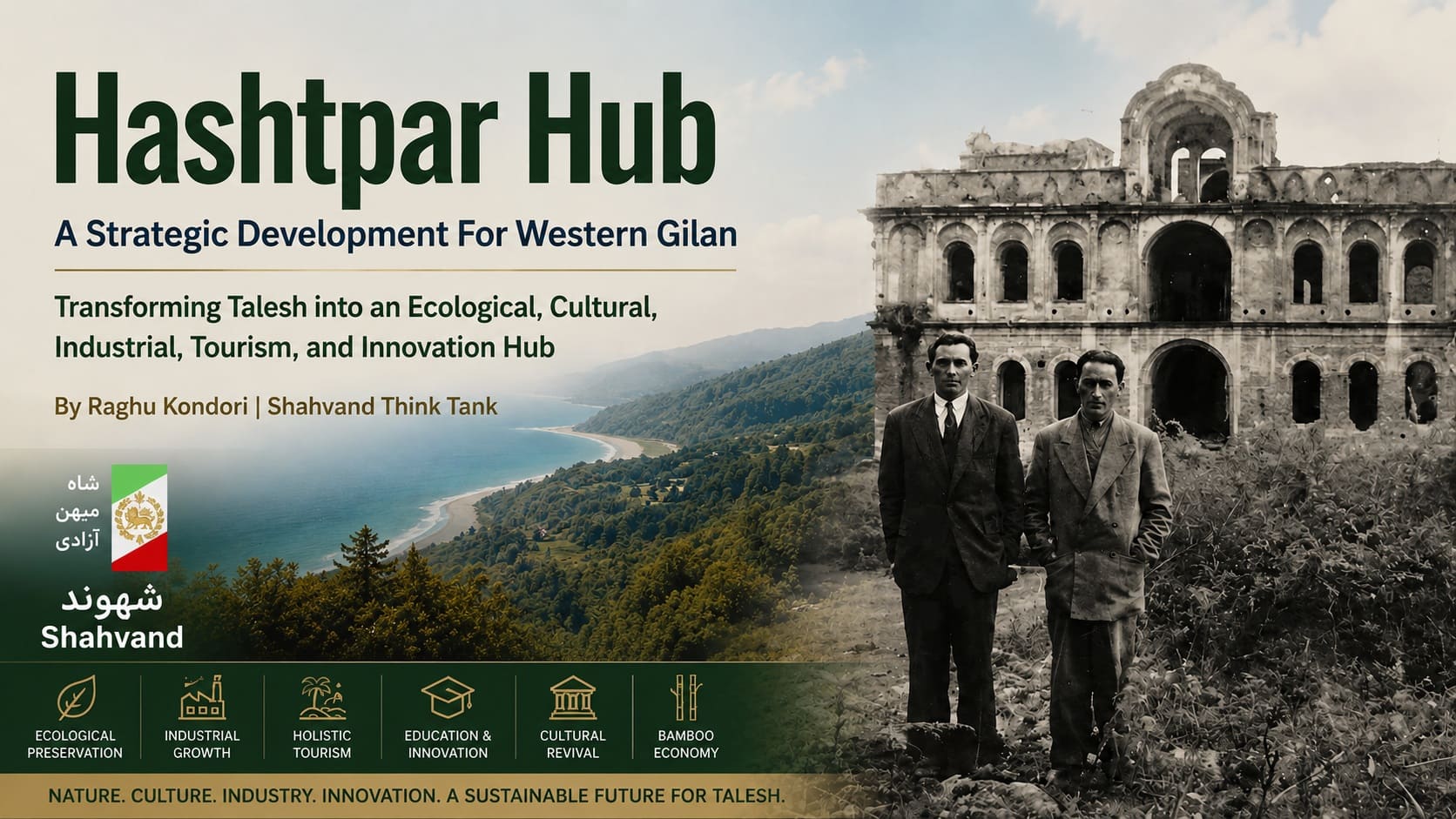
At the center of this vision stands the revitalization of Amjad Sardar Palace. Rather than remaining an abandoned historical structure, the palace would be transformed into a Museum of Talesh History and Culture dedicated to the language, architecture, anthropology, music, traditions, and historical memory of the Tavalesh people.
The palace becomes both a museum and a symbolic landmark of Talesh itself.
Another major cultural project concerns the complete redevelopment of the historic Soroodi Bookshop site.
For nearly eighty-five years, Soroodi Bookshop occupied a unique place within the intellectual and educational life of western Gilan. During a period when even larger northern cities such as Astara and Bandar Anzali still lacked bookstores, Soroodi had already become a center for books, newspapers, magazines, photography, stationery, and public culture.
For generations of students across Talesh, the bookstore functioned as one of the primary places for obtaining school textbooks and educational material. In practical terms, it operated as an unofficial educational distribution center for the region itself.
Soroodi was not only associated with bookselling. He was also active in journalism and occasionally published reports and news related to Hashtpar and Talesh in national newspapers, helping connect the region to the wider cultural and media landscape of Iran.
The bookstore also maintained a strong connection to photography and camera culture during an important historical period of the region. Over decades, large numbers of photographs documenting daily life, schools, streets, families, ceremonies, landscapes, agriculture, and social transformation in Talesh were produced and preserved.
Today the original structure stands in complete ruin and cannot realistically be restored. The project therefore proposes the demolition of the remaining building and the construction of a new four- to six-floor cultural institution on the existing urban plot together with its approximately five-hundred-square-meter rear land reserve.
The new institution would be called:
Soroodi Cultural Center
The center is envisioned not merely as a library, but as one of the principal civic and intellectual institutions of future Hashtpar.
The building would integrate:
public library spaces, modern reading halls, digital learning areas, historical archives,
photography and visual-memory collections, conference halls, theater spaces, artistic workshops, cultural exhibitions,public lecture facilities, and civic gathering areas.
The ground floor would remain socially open and integrated into urban life through bookstores, exhibition spaces, and public gathering zones.
One of the most important dimensions of the center is the preservation of the visual memory of Talesh itself. Historical photographs, newspapers, publications, printing culture, camera collections, and documentary archives would become part of a permanent historical and cultural archive dedicated to preserving the social memory of western Gilan.
The project could eventually establish one of the first major regional digital memory archives in northern Iran through the digitization of photographs, publications, and local historical records.
Architecturally, the Soroodi Cultural Center reflects the broader philosophy of the Hashtpar Hub:
modern yet rooted, contemporary yet connected to memory, urban yet human-centered.
The building can integrate natural light, ecological materials, internal courtyards, green rooftop spaces, reading terraces, and panoramic views connecting the city to the surrounding landscape.
Upper floors or rooftop spaces may include cultural cafés and public terraces overlooking Hashtpar and the surrounding ecology.
The proposal also includes the creation of riverside hilltop parks overlooking the Caspian landscape together with green public corridors, cafés, walking paths, ecological recreation zones, and urban public spaces designed to increase quality of life and tourism attractiveness.
Education infrastructure forms another major component of the urban-cultural axis. Following the educational architecture model previously developed in Shahvand Think Tank’s Kurdistan school proposal, Hashtpar can become one of the pilot regions for a new generation of educational campuses in Iran.
These schools integrate climate-adapted architecture, central courtyards, laboratories, libraries, sports facilities, cultural halls, artistic spaces, and intelligent transportation access systems.
Alongside educational modernization, the project supports the development of regional sports clubs and athletic infrastructure focused on football, wrestling, volleyball, swimming, martial arts, athletics, and youth development systems.
Finally, the proposal prioritizes pedestrian-oriented urbanism. Walkable districts, riverside pathways, interconnected cultural spaces, green corridors, and intelligent transportation systems gradually transform Hashtpar into a human-centered city attractive to investors, educators, entrepreneurs, returning diaspora communities, artists, and skilled professionals.
Amjad Sardar Palace Museum
At the symbolic center of Talesh stands Amjad Sardar Palace — one of the most recognizable historical landmarks and cultural icons of the region. For generations, the palace occupied a unique place in the collective memory of Hashtpar and western Gilan. More than a historical structure, it represented a visible connection between the social history of Talesh and its architectural identity.
The proposal transforms Amjad Sardar Palace into the Museum of Talesh History and Culture, establishing it as the principal heritage institution of the region and one of the central cultural pillars of the Hashtpar Hub.
The palace would preserve and present the historical memory of Talesh through exhibitions dedicated to language, music, traditional clothing, oral history, architecture, agriculture, mountain life, coastal culture, family histories, and the relationship between the Tavalesh people and the Hyrcanian environment.
Rather than functioning as a static museum, the palace would become a living cultural space capable of hosting exhibitions, festivals, lectures, artistic programs, educational visits, heritage events, and tourism activities throughout the year.
Architecturally, the palace would remain one of the visual anchors of Hashtpar itself — a recognizable landmark connecting the historical identity of Talesh to its future modernization.
In the broader structure of the Hashtpar Hub, Amjad Sardar Palace becomes the heritage and historical icon of Talesh, while the Soroodi Cultural Center becomes the intellectual and civic memory center of the city. Together, they form the cultural backbone of the entire regional transformation project.
Axis 5 — Talesh Bamboo Value-Chain Hub
One of the most distinctive components of the Hashtpar Hub is the creation of a complete bamboo economic ecosystem.
Western Gilan’s humid ecological conditions are highly suitable for bamboo cultivation and processing. Bamboo already exists within Gilan’s traditional craft culture but remains economically underdeveloped as a modern industrial and design sector.
The proposal establishes the Talesh Bamboo Value-Chain Hub as a regional center for bamboo processing, manufacturing, branding, tourism integration, and ecological material innovation.
The system purchases bamboo from local growers and transforms it into high-value products including handicrafts, decorative architecture, wall and ceiling panels, eco-furniture, balcony structures, garden systems, bamboo cafés, pergolas, tourism décor, composite boards, ecological packaging, and lightweight construction materials.
The bamboo ecosystem integrates directly into the tourism strategy itself. Bamboo architecture becomes part of Hyrcan Holiday, ecological cafés, meditation centers, wellness retreats, and eco-tourism villages.
This creates a distinctive regional identity built around:
forest, sea, bamboo, and wellness culture.
The bamboo sector also supports artisan entrepreneurship, women-led industries, rural employment, ecological exports, reduced plastic dependency, and low-carbon industrial growth.
Axis 6 — Ecological Preservation and Smart Growth
The Hashtpar Hub is built upon one central principle:
The Hyrcanian ecosystem is not an obstacle to development.
It is the foundation of development itself.
Forest preservation, coastline protection, ecological zoning, renewable energy integration, smart waste systems, sustainable water management, and controlled urban expansion become structural principles of the project.
Rather than repeating the uncontrolled coastal destruction visible in many tourism regions around the world, the Hashtpar Hub adopts a model of smart ecological urbanism balancing economic growth, tourism, environmental sustainability, and long-term livability.
The project transforms preservation itself into an economic asset through ecological tourism, wellness industries, bamboo innovation, forest therapy systems, and sustainable urban planning.
Funding and Implementation
The financing structure combines private-sector participation, public-private partnerships, banking and investment financing, and public infrastructure support.
Development occurs in three major phases.
The first phase focuses on infrastructure, utilities, industrial groundwork, ecological zoning, bamboo pilot systems, and transportation networks.
The second phase includes the construction of Hyrcan Holiday, university launch, industrial scaling, and major cultural projects including the Soroodi Cultural Center.
The third phase consolidates international tourism integration, export expansion, innovation ecosystems, ecological urban maturity, and global regional branding.
Strategic Outcome
The Hashtpar Hub transforms western Gilan into:
an ecological tourism destination,
a premium agro-industrial exporter,
a bamboo innovation ecosystem,
a cultural-modern urban center,
and a knowledge-based regional economy.
More importantly, the project demonstrates that modernization does not require the destruction of memory, identity, or nature.
Economic development and ecological preservation become mutually reinforcing forces rather than opposing ones.
In this vision, Talesh evolves into a region that is not only wealthier, but more coherent, more educated, more beautiful, more livable, and more resilient.
A regional model where prosperity, culture, memory, and preservation grow together.