
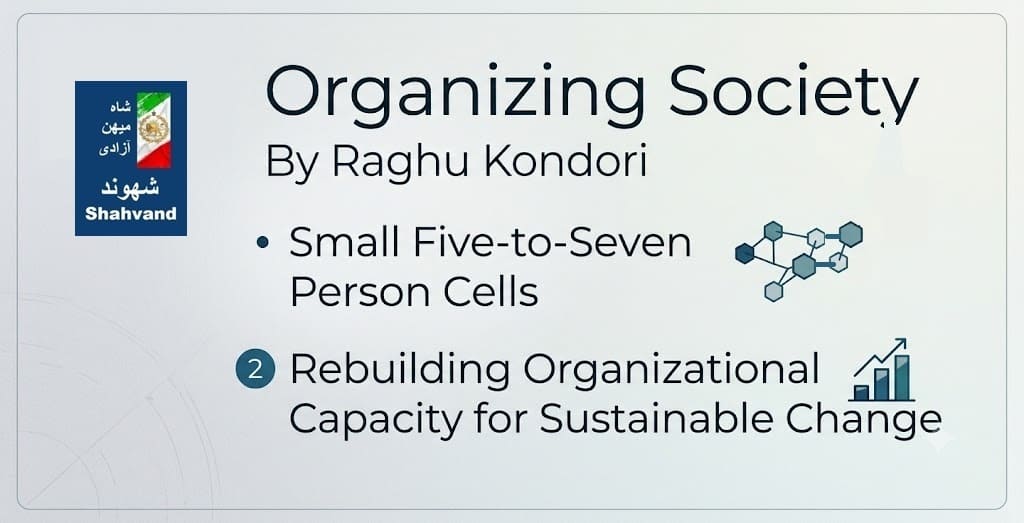
Small Five-to-Seven Person Cells; Rebuilding Organizational Capacity for Sustainable Change. By Raghu Kondori
The Islamic Republic has endured less through raw repression than through its organizational superiority. An integrated network stretching from mosques and the Basij to the Revolutionary Guards, administrative bodies, the judiciary, and the media enables the government to detect and contain any movement before it can expand. The opposition lacks any comparable infrastructure and remains overly focused on content production, waiting for a crisis or foreign intervention, and debating the future leader. The result is an abundance of media and a shortage of organization.
A realistic approach must fit Iran’s security conditions. Instead of building nationwide hierarchical structures that are quickly penetrable, it is better to form small five-to-seven person cells. This size provides greater resilience and logistical capacity while remaining small and controllable. Each cell has only a limited mission, and members of different cells do not know one another.
These cells should not be purely political. If they form around social assistance, education, the environment, cultural activities, or economic cooperation, they become harder to identify and gradually rebuild the social trust damaged by the costly protests of recent years. Only some of them would enter political action at the appropriate time. Focusing on medium-sized and smaller cities, where security surveillance is lighter than in Tehran, increases the chances of sustainability.
From now on, internal group contact without communication apps, without phones, and without the internet should be practiced. In crisis situations when networks are cut, groups that have already tested alternative methods can maintain their coordination. Division of roles among content production, education, financial support, documentation, and local networking is also essential so that not everyone bears the burden of street protest.
The short-term goal should not be solely overthrow. The goal should be increasing society’s organizational capacity. A society that becomes organized can eventually bring about political change; a society without organization, even after the fall of the regime, will remain vulnerable to chaos. Any form of organizing must remain peaceful, as legal as possible, and prioritize the safety of individuals. Without this infrastructure, the courage that has been repeatedly demonstrated in Iran will once again lead to high costs and limited results.