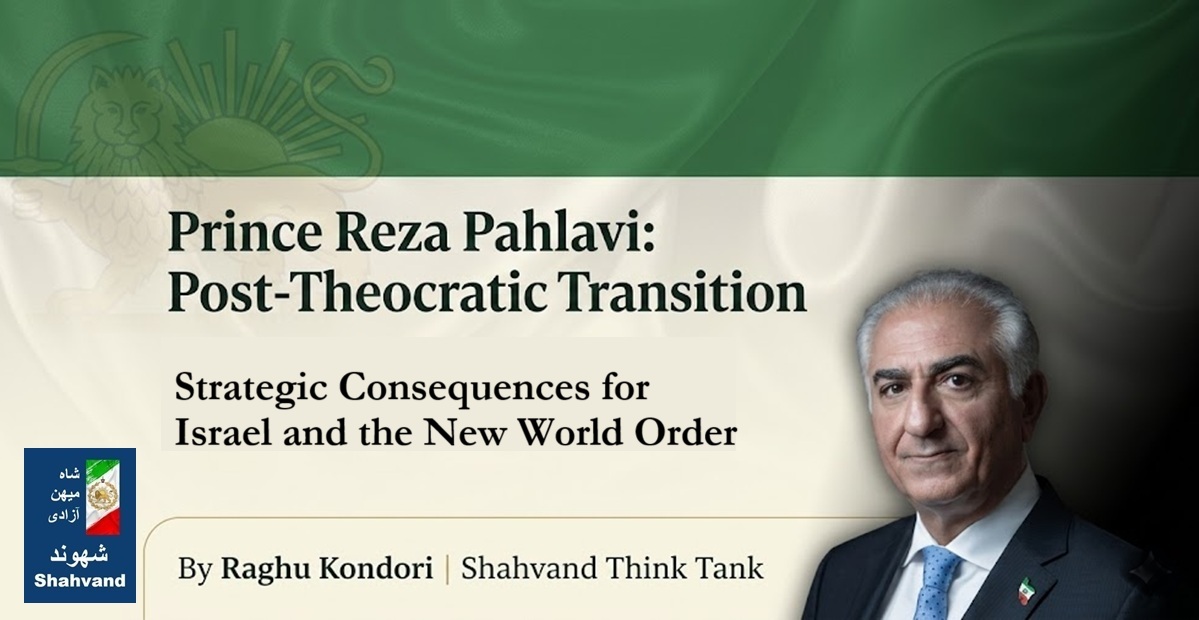

Strategic Consequences for Israel and the New World Order.
By Raghu Kondori | Shahvand Think Tank.
Iran faces a structural rupture. For the global order, the critical question is no longer if the current system will fall, but what replaces it. The answer will define Middle Eastern security and global energy flows for a generation.
Prince Reza Pahlavi’s vision of a secular, democratic Iran is not nostalgic but strategically essential. It offers a credible civilian alternative to theocracy. By dismantling the clerical state, this secular framework removes the theological justification for exporting revolution or waging civilizational war against neighbors. A transition based on popular sovereignty makes foreign adventurism a political liability, redirecting Iran’s vast national resources toward internal stability, reconstruction, and the welfare of its citizens.
Cyrus Accord
Central to this regional peace is the Cyrus Accord, a proposed framework for a trade and transit corridor linking Iran, Iraq, Jordan, and Israel. By embedding economic interdependence, the accord transforms peace into a tangible material benefit, completing the logic of the Abraham Accords by neutralizing the primary source of ideological opposition. As we see in moments of significant systemic pressure, there is immense room for new entities to emerge that respect user choice and economic agency over state-mandated dogma.
Globally, a democratic Iran disrupts the strategies of rival powers. A normalized Iran exporting energy freely would erode Russia’s leverage over global markets and strain the energy security of powers like China, which currently rely on sanctioned, non-transparent suppliers. Furthermore, by restoring Iran’s pre-Islamic heritage of pluralism, this transition counters the regime’s weaponized narrative with a civilizational shift toward co-existence.
The transition will be a defining test of the emerging global order. Pahlavi’s framework aligns democratic legitimacy with regional security, offering a path to resolve core threats through structural transformation and economic prosperity rather than endless force.