After the Mullahs
Noor, Homeland, Freedom and Iran’s Moral Rebirth
By Raghu Kondori | Shahvand Think Tank
Iran stands at a civilizational threshold. The Islamic Republic—hollowed by repression, corruption, and exhaustion—moves toward its inevitable end. The signs no longer require interpretation: collapsing institutions, demographic flight, ecological freefall, and a ruling class with neither competence nor moral standing. What awaits Iran is not merely a political transition. It is the reconstruction of coherence after four decades of disintegration—a return to an awakened Iranian identity.
The Path Forward
Iran’s recovery demands a political architecture capable of unifying a fractured society while satisfying the world’s need for a stable, responsible post-Islamic Republic state. The only model that fits the historical, cultural, and geopolitical realities of Iran is a secular parliamentary monarchy: a system that restores continuity without reviving absolutism, and delivers democratic accountability without collapsing into factional chaos.
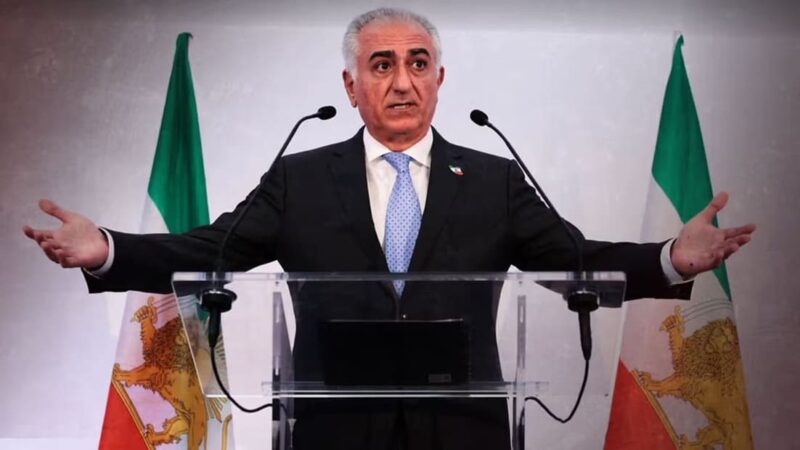
In such a constitutional settlement, Princess Noor Pahlavi becomes the symbolic anchor of unity—a cultural monarch whose authority is national rather than political. Meanwhile, Prince Reza Pahlavi, as the Father of the New Iran, plays the role he is uniquely positioned for: the strategic leader of reconstruction. His mandate comes not by dynastic right but by national consent. If he seeks executive office—for example, as Prime Minister—he does so through open democratic competition, accountable to parliament and the electorate.
This dual structure—symbolic continuity paired with democratic governance—is Iran’s best chance for a peaceful rebirth.
A Three-Phase Roadmap
1. Transition (6 months–2 years): Restoring Legitimacy
No system can be born without legitimacy, and legitimacy cannot be manufactured. A technocratic interim government—neutral, limited, and internationally supported—must focus on stabilizing society, ensuring food security, preventing fragmentation, and preparing the foundational act of the new era: a national referendum on the future structure of the state.
Republic or monarchy—the people must choose.
Without this moment, no constitution will endure.
If the nation chooses a parliamentary monarchy, the next parliament drafts the new constitution, institutionalizing the monarchy as symbolic, the government as accountable, and sovereignty as rooted in the people.
2. Stability (3–5 years): Building the Constitutional Order
Stability comes from rules, not personalities. Iran’s political forces—monarchist, republican, liberal, social, conservative—must compete openly under law, not in exile or underground.
Parliament becomes the arena where political power is earned and replaced.
Queen Noor, as Monarch of Iran, provides cultural and historic coherence.
Reza Pahlavi, still accountable to the voting public, guides national reconstruction and political reform.
This equilibrium—unity from above, competition below—is the architecture of a durable democratic state.
3. Prosperity (5–10 years): Confronting the Real Existential Crisis
All political debates collapse before one reality: Iran is running out of water. Without water, economic plans are fantasies; without geography, identity dissolves.
The Iran Prosperity Project—rooted in Reza Pahlavi’s long-matured reform vision—must make water security, environmental recovery, economic revitalization, and international reintegration its primary agenda. Foreign investment, regional diplomacy, cultural revival, and technological modernization are meaningless unless the land itself survives.
Prosperity is not a slogan. It is a moral obligation to the territory that defines us.
Light, Homeland, Freedom
At the center of the rebirth stands a triad—a political philosophy and a moral covenant:
Light (Noor): truth, transparency, accountability.
Homeland (Mihan): identity, memory, geographic rootedness.
Freedom (Azadi): pluralism, agency, creative possibility.
The Islamic Republic thrived on darkness—on secrecy, coercion, and fragmentation. Iran’s renewal demands the opposite: clarity instead of propaganda, rootedness instead of ideological abstraction, and freedom instead of fear.
This triad is not a slogan. It is the architecture of Iran’s recovery.
Symbolism, Governance, and the West
A secular parliamentary monarchy is not nostalgia. It is evolution.
It prevents the concentration of power that has repeatedly destroyed Iran’s institutions, while still providing a unifying center of gravity that a fragile transitioning society desperately needs.
Queen Noor represents continuity, legitimacy, and the cultural dimension of sovereignty—an anchor no elected office can provide.
Reza Pahlavi represents the moral bridge between Iran’s wounded modernity and its democratic future.
This is exactly the model Western governments quietly expect:
stability without dictatorship,
democracy without fragmentation,
continuity without theocracy.
It is Iran’s clearest path back into the international community as a responsible, confident, modern state.
The Battle Ahead
The Islamic Republic survived by cultivating darkness—fear, disinformation, the marginalization of identity, the destruction of trust. Iran’s rebirth will require the opposite: transparent governance, cultural grounding, and institutional honesty.
The struggle is not simply political. It is civilizational.
Iran must recover truth, unity, and moral purpose after decades of disintegration and humiliation.
Covenant for the Future
Light, Homeland, Freedom—this is the architecture of the next Iran.
A secular parliamentary monarchy, with Queen Noor as the symbolic anchor and Reza Pahlavi leading the Iran Prosperity Project, is the one model that unifies cultural memory, democratic aspiration, and geopolitical stability.
Iran’s next chapter will not be shaped by ideology but by clarity, identity, and freedom.
The covenant is simple:
Light for truth.
Homeland for unity.
Freedom for creation.
Together they form the blueprint for Iran’s moral and political rebirth—the most credible, stable, and ethical path after the mullahs.
Noor Homeland Freedom
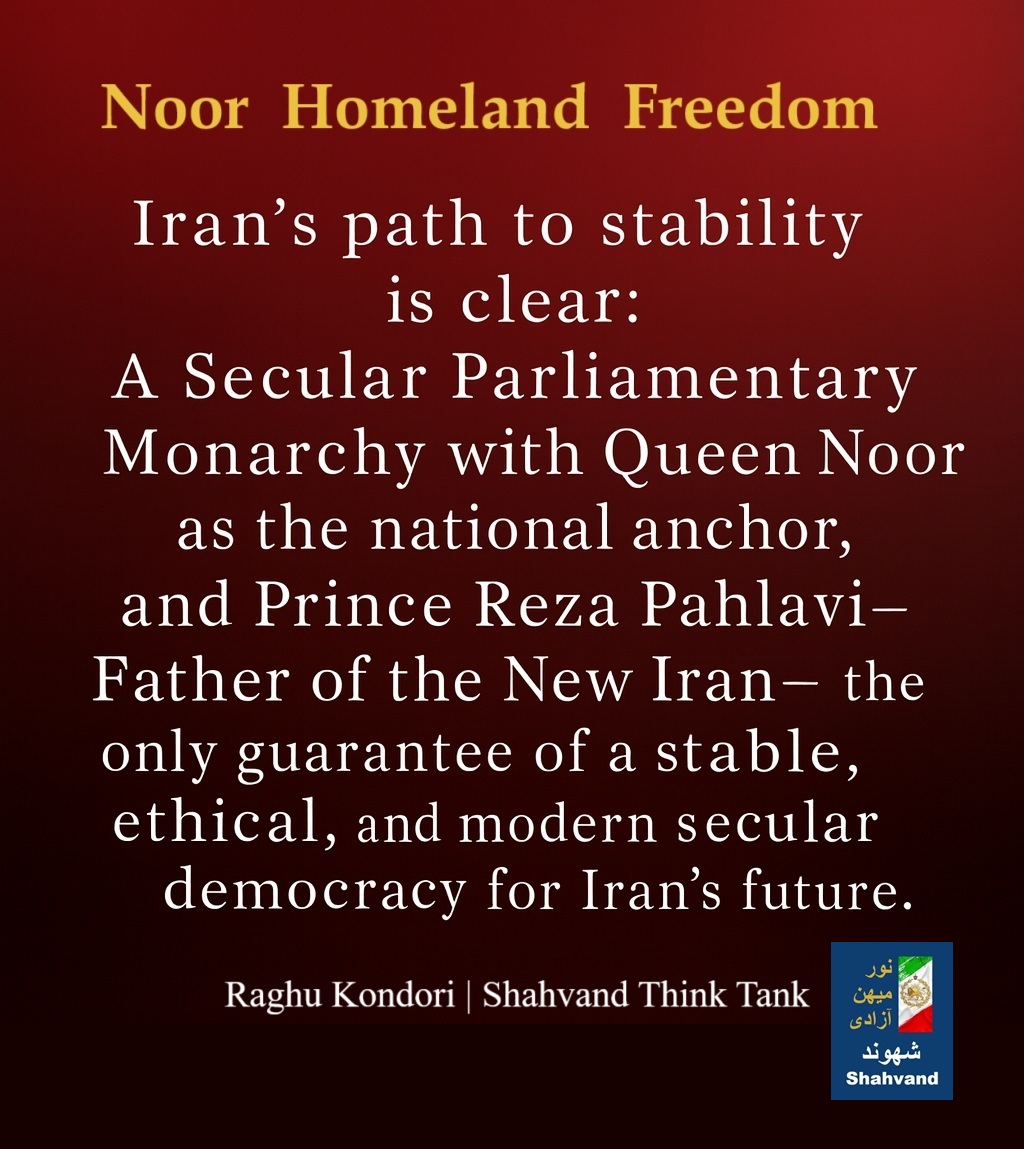
Iran’s path to stability is clear: A Secular Parliamentary Monarchy with Queen Noor as the national anchor, and Prince Reza Pahlavi—Father of the New Iran—leading the Iran Prosperity Project, the only guarantee of a stable, ethical, and modern secular democracy for Iran’s future.