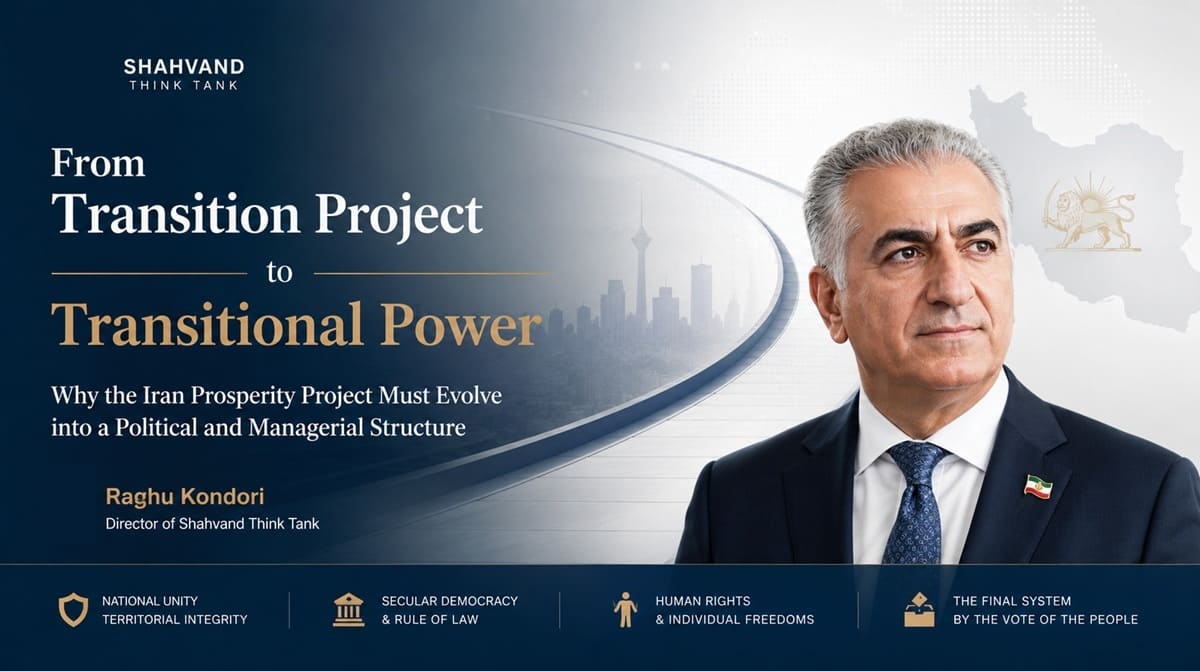
Why the I.P.P Must Evolve into a Political and Managerial Structure? By Raghu Kondori
In recent years, the Iranian opposition has achieved notable progress in areas such as discourse-building, delegitimizing the political authority of the Islamic Republic, and creating a relative convergence around certain foundational principles for Iran’s future. However, a decisive question remains unanswered both within Iranian society and among international actors: if political change occurs, which force will assume responsibility for governing the country during the transitional period?
In the logic of international politics, there is a fundamental distinction between “support for a political or human rights cause” and “recognition of a governing alternative.” Many states may express sympathy with democracy, human rights, or popular demands; however, when the issue shifts toward political transition, their approach naturally moves from the normative to the institutional and operational level. At that stage, the central question becomes: which entity, which team, and through which executive mechanism will the country be governed after the transition?
From this perspective, the policy of “maximum pressure” on the Islamic Republic is understandable for foreign actors, as its tools are concrete and measurable: War and Negotiation, economic sanctions, diplomatic isolation, and the restriction of financial and political resources of the regime. However, when the discussion shifts to “maximum support for the Iranian people,” a structural ambiguity emerges. Support for what exact political structure? Represented by whom? And implemented by which governing team?
At this point, the issue of a “power vacuum” during transition becomes a real concern. Experience shows that even when a political leader possesses significant social capital, the absence of a cohesive political and managerial team can create the perception at the international level that the post-regime phase will be marked by instability and lack of governance structure. This concern directly affects the depth and willingness of external support.
In the current Iranian context, a significant portion of the opposition, both inside and outside the country, views prince Reza Pahlavi as the central figures of the opposition during the transitional phase. This social reality constitutes an important political asset that has developed over time. However, social capital alone is not sufficient to manage a complex political transition.
Within this framework, the “Iran Prosperity Project” requires a developmental shift: moving from the level of a conceptual vision or political project to the level of an operational political and managerial structure. This transformation requires the formation and presentation of a political, executive, and expert team capable of demonstrating decision-making and implementation capacity in key governance areas, including national security, economy, foreign policy, water and energy crisis management, education, and institutional reconstruction.
An important point in this regard is that such a structure should not define itself merely as a “transition project,” but rather as a “transitional power”—a force that is both grounded in social legitimacy and capable of demonstrating practical governance competence. In this sense, experts and technocrats play a crucial advisory role, while the core responsibility rests with an experienced managerial-political nucleus capable of crisis governance.
Ultimately, the central issue in today’s Iranian context is no longer merely the necessity of change, but the management of its consequences. The clearer, more structured, and more operational the answer to this question becomes, the greater the level of domestic trust and international willingness to support a real transition will be.
A successful transition is not merely the collapse of an old order; it requires the timely emergence of a credible and functional alternative. The distinction between a “transition project” and a “transitional power” lies precisely in the ability to transform social capital into an executable governance capacity. This text is presented as an intra-discursive critique aimed not at rejecting political leadership, but at strengthening its institutional and operational readiness for a critical transitional phase.