Shah – Homeland – Freedom
The Realist Case for Iran’s Civilizational Restoration. By Raghu Kondori, Director of Shahvand Think Tank.
Beyond Regime Change: Why National Continuity Is the Only Path to Regional Stability.
The approaching collapse of the Islamic Republic places Iran at a moment that is often misread. This is not merely the end of a regime. It is the convergence of two crises at once: a political vacuum and a civilizational disorientation. When these appear together, history suggests the danger is not only instability, but repetition—old forces returning under new language.
The real question facing Iran is therefore no longer who replaces the Islamic Republic. It is whether Iran can reconstruct a state capable of surviving beyond the first election, the first referendum, or the first wave of revolutionary enthusiasm. Without a stable frame of orientation, collapse becomes an open invitation to ideological recycling.
Iran has already lived through this cycle.
The 1979 revolution did not simply remove a governing system; it severed civilizational continuity. That rupture allowed ideology to occupy institutions that should have remained neutral and durable. The result was a permanent revolutionary state—structurally dependent on conflict, incapable of normal relations with its neighbors, and increasingly alien to its own society. Any post-Islamic transition that ignores this lesson risks repeating it, even if the language is secular or populist rather than clerical.
Universities and the End of Ideological Drift
What distinguishes the current uprising is not only its persistence, but its cultural realignment, particularly within universities. For decades, Iranian academic spaces were dominated by a mix of leftist abstraction, reformist paralysis, and enforced apathy. This environment suited the regime. It produced critique without direction and dissent without consequence.
That phase is ending
Universities are no longer neutral cultural buffers. Students and academic spaces are increasingly synchronized with street protests, and more importantly, the language has changed. The slogans emerging from campuses are not about reform, negotiation, or ideological compromise. They are historically grounded and strategically clear.
“This is the final battle. Pahlavi will return. Javid Shah.”
The importance of this slogan lies less in emotion than in exclusion. It excludes Islamist legitimacy. It excludes leftist moral monopoly. It rejects the idea that Iran must reinvent itself from zero after every rupture. What is re-emerging is national continuity as a political principle.
For the first time since 1979, Iranian identity itself—rather than ideology—is becoming the organizing force of opposition.
October 7 and the Regime’s Strategic Exposure
The October 7 attacks accelerated this realignment. The Islamic Republic eliminated any remaining ambiguity about its global posture by openly aligning with terrorism and antisemitic violence. Its revolutionary identity was no longer rhetorical; it was operational.
The Iranian people responded in the opposite direction.
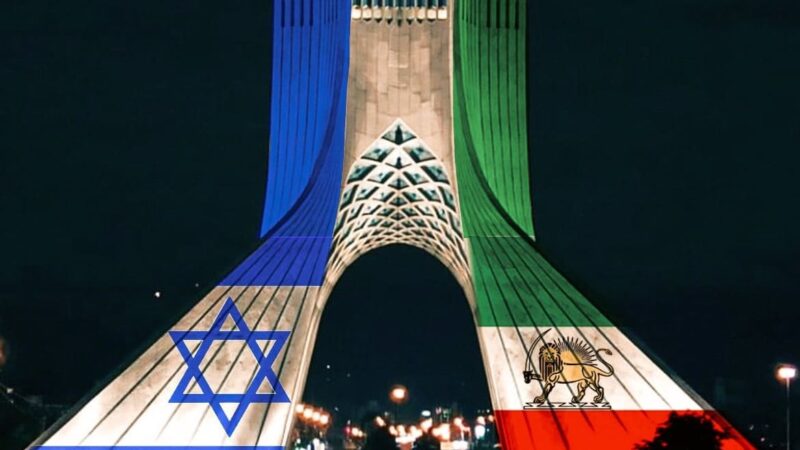
Across multiple cities worldwide, Iranians demonstrated with the Lion and Sun flag, openly expressing solidarity with Israel. This was not tactical positioning. It was a civilizational signal. It underscored a reality long suppressed: hostility toward Israel is not Iranian tradition, but revolutionary doctrine imposed by force.
The historical relationship between Iran and Israel—ruptured by the Islamic Republic, not by the Iranian nation—returned to public consciousness. Israel’s consistent effort to distinguish between the regime and the Iranian people reinforced this divide. By treating Iranians as a captive society rather than an enemy population, Israel indirectly strengthened the legitimacy of Prince Reza Pahlavi as a national figure rather than a factional actor.
Strategically, this distinction matters. It weakens the regime’s claim to represent Iran externally and reinforces the possibility of Iran’s reintegration into the regional security architecture without ideological hostility.
Collapse Is the Easy Part
The fall of the Islamic Republic, whenever it occurs, will not automatically produce a stable Iran. The most dangerous phase begins afterward.
Leftist and Islamist networks do not disappear with regime change; they adapt. They soften language while preserving objectives. Under slogans of peace, justice, or anti-imperialism, the same ideological structures—anti-American, antisemitic, and hostile to liberal order—can re-enter power through democratic mechanisms if the transition lacks clear boundaries.
From a U.S. and Israeli defense perspective, this is a familiar pattern: regime collapse without institutional neutralization produces gray-zone threats, proxy regeneration, and asymmetric destabilization.
This is why slogans matter strategically. They define legitimacy. They constrain the range of acceptable futures. A transition without civilizational clarity invites ideological re-entry through procedural means.
The Parliamentary Monarchy as Structural Correction
A Parliamentary Monarchy matters not because of symbolism, but because it addresses a structural problem that revolutionary systems consistently fail to resolve.
It separates civilizational continuity from day-to-day governance. It anchors national identity above factional politics. It removes the need for ideological legitimacy by restoring historical legitimacy within a constitutional framework.
This model is not theoretical. Spain’s transition after Franco demonstrated how monarchy provided continuity while democratic institutions emerged without revolutionary rupture. Cambodia’s constitutional monarchy played a similar role after decades of ideological devastation, offering national cohesion without authoritarian restoration. In both cases, monarchy functioned as a stabilizing framework, not a governing ideology.
For Iran, the logic is even stronger. Iran is not merely a modern nation-state; it is a civilizational state—older than its contemporary borders, languages, and political systems. Attempts to compress such a civilization into ideological republics have repeatedly produced instability.
A Parliamentary Monarchy allows Iran to function as a civilizational state with democratic governance, rather than as an ideological project in permanent crisis.
For the United States, this model reduces strategic uncertainty and lowers the risk of post-collapse adversarial realignment. For Israel, it removes the ideological driver of Iranian hostility that has underpinned decades of asymmetric warfare. For regional and global energy markets, it signals rule-based governance instead of sanctions-driven volatility. In realist terms, it is the only post-Islamic framework that allows Iran to become a net contributor to regional stability rather than a persistent security liability.
Dismantling the Parallel State: End, Reclaim, Integrate
The IRGC is not just a military actor—it is a hybrid threat organization, combining armed force, intelligence, ideological enforcement, and economic dominance. Its survival under any transitional government would make Iran ungovernable and a persistent regional threat. A post-Islamic transition must follow a disciplined triad: end the parallel state, reclaim the economy, integrate capability without ideology.
1. End the Parallel State The IRGC’s independent command, intelligence apparatus, and ideological oversight—most notably the Supreme Leader’s Representation—must be dissolved. This is institutional sunsetting, not punitive. The goal is a unified national defense under the Artesh, accountable to the constitution and civilian leadership. From a U.S. and Israeli security perspective, this neutralizes the IRGC’s capacity for proxy operations and internal interference.
2. Reclaim the Economy The IRGC dominates up to half of Iran’s economy—from construction conglomerates to telecommunications and banking—creating a militarized economic ecosystem that finances regional operations. Assets should be transferred to a National Recovery Fund to prevent oligarchic capture, then privatized transparently. This restores markets, strengthens the middle class, and dismantles the financial backbone of the so-called “Resistance Economy,” reducing systemic instability.
3. Integrate Capability Without Ideology A scorched-earth purge risks insurgency. Professional and technical units—Aerospace, Navy, Missile, Satellite—should be audited and integrated into the Artesh. Personnel tied to ideological enforcement or domestic repression must be barred. This preserves operational expertise while ensuring that the military is loyal to the constitution and the state, not to doctrine or clerical authority. From a JST and U.S./Israeli strategic perspective, this neutralizes asymmetric threats while retaining Iran’s defensive capabilities.
Civilizational Continuity and Ethnic Pluralism
Iran’s civilizational identity is not ethnic uniformity; it is historical coexistence.
Persians, Azeris, Kurds, Baluchs, Arabs, Lurs, Turkmen, and others have all belonged to Iran’s civilizational space long before modern nationalism or ideological rule. The Islamic Republic exploited ethnic grievances by centralizing power without equality. Ideological republics, by definition, demand uniformity of belief.
Civilizational continuity offers a different logic.
The Lion and Sun flag functions as an inclusive umbrella precisely because it predates ideological division. It does not belong to one ethnicity, sect, or political movement. It represents Mihan—the homeland—as a shared civilizational space rather than an ideological construct.
Within a secular democratic framework, equality of citizenship—men and women, all ethnicities, all regions—can coexist with decentralization, cultural rights, and administrative self-management without threatening national unity. This balance is only possible when the state’s legitimacy is civilizational and constitutional, not ideological.
In this sense, continuity is not exclusionary. It is the condition that allows pluralism to survive without fragmentation.
Shah Homeland Freedom
The slogan “Shah Homeland Freedom” is not a campaign phrase. It is a boundary-setting formula.
Shah represents constitutional continuity above political competition. Homeland anchors sovereignty in civilizational identity rather than ideology. Freedom defines the system as secular, democratic, and rights-based without ambiguity.
Together, they close the door to ideological relapse while preserving space for democratic pluralism.
Iran needs a regime change with a clear orientation. A political vacuum without civilizational clarity leads to chaos or repetition. Civilizational rhetoric without democratic structure leads to authoritarianism. The strength of a Parliamentary Monarchy—articulated through Shah, Homeland, Freedom—is that it addresses both simultaneously.
Ultimately, the final word will rest with the Iranian people themselves, under the guidance of Prince Reza Pahlavi as a non-violent, democratically committed transitional leader. He will oversee a free referendum to choose between republic or monarchy, followed by the election of a new parliament and the drafting of a new constitution. Only through this process can legitimacy be restored, authority normalized, and Iran’s post-Islamic order anchored in popular sovereignty rather than ideology.
What replaces the Islamic Republic will matter more than how it falls.
Raghu Kondori, Director of Shahvand Think Tank
01/01/ 2026