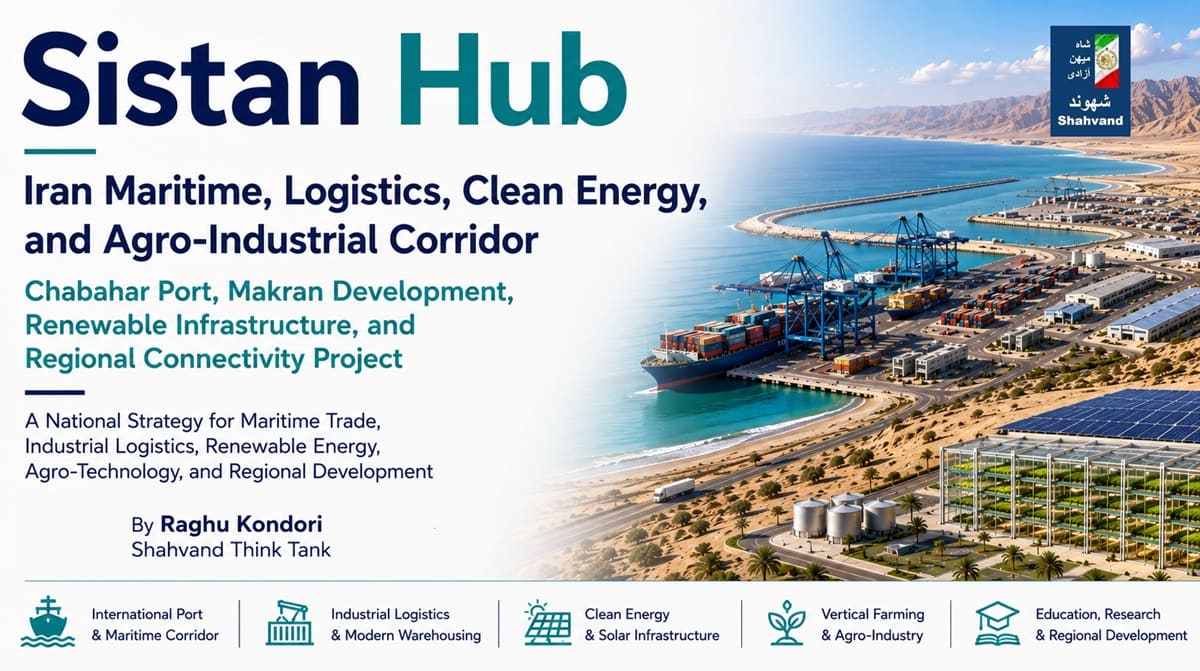

Iran Maritime, Logistics, Clean Energy, and Agro-Industrial Corridor
Raghu Kondori | Shahvand Think Tank
Chabahar Port, Makran Development, Renewable Infrastructure, and Regional Connectivity Project
A National Strategy for Maritime Trade, Industrial Logistics, Renewable Energy, Agro-Technology, and Regional Development
The future development of Sistan and Baluchestan should not be reduced to a single industrial sector or symbolic technological slogan. The strategic potential of the region emerges from the interaction between geography, maritime access, logistics, renewable energy, agriculture, industrial expansion, education, and regional connectivity.
Rather than attempting to artificially transform the region into a software-centered technological hub disconnected from its geography, this proposal envisions a long-term multi-ring development corridor rooted in the structural realities of the Makran coast and the Sistan region itself.
The project proposes the gradual emergence of Sistan as: a maritime gateway,
a logistics corridor, a renewable-energy territory, an agro-industrial ecosystem,
an eco-tourism region, and a long-term educational and industrial development zone.
The objective is not isolated urban growth, but the construction of an interconnected regional ecosystem capable of generating employment, industrial capacity, educational development, middle-class expansion, and long-term regional stability.
Chabahar International Maritime Corridor
At the center of the proposal stands Chabahar Port as a modern international maritime and logistics gateway connected to the Indian Ocean and broader regional trade routes.
The project envisions the long-term transformation of Chabahar into:
a modern international port, a regional logistics center, a maritime-industrial corridor,
and a strategic gateway connecting Iran toward: India, the Gulf region, Central Asia,
the Caucasus, East Africa, and broader Indian Ocean trade networks.
This includes the gradual development of:
modern port terminals, smart customs systems, automated cargo systems, container logistics infrastructure, freight rail integration, maritime transport facilities, industrial logistics zones, and free-trade commercial corridors.
The proposal also includes the development of:
modern storage warehouses, high-capacity industrial warehousing, cold-chain logistics systems, frozen storage industries, food preservation infrastructure, export packaging facilities, and regional distribution centers connected to maritime and land transport systems.
The objective is to transform Chabahar from a peripheral port into one of Iran’s principal international logistics and maritime gateways.
Renewable Energy and Desert Infrastructure
The deserts and open land of Sistan provide strong conditions for large-scale renewable-energy infrastructure.
The proposal includes the gradual construction of:
solar-energy corridors, rooftop solar systems, clean-energy industrial parks, energy-storage infrastructure, desalination systems, and energy networks supporting industrial and agricultural development.
Renewable energy becomes the structural foundation supporting:
industrial logistics, agro-technology, vertical farming, water-management systems, cold-storage industries, and future industrial expansion.
The objective is to transform the region from a historically peripheral territory into a strategic energy and industrial corridor integrated into the future economic architecture of Iran.
Agro-Technology and Vertical Farming Ecosystem
One of the central dimensions of the project is the development of large-scale agro-technological systems adapted to desert conditions.
The proposal envisions:
vertical farming complexes, hydroponic systems, aquaponic ecosystems, controlled-temperature agricultural structures, and multi-floor agricultural production facilities integrated with renewable energy systems.
The farming systems would combine:
water-based plant cultivation, aquatic ecosystems, natural nutrient circulation,
controlled lighting systems, and protected thermal architecture capable of sustaining year-round agricultural production.
The use of daytime sunlight through architectural openings combined with nighttime agricultural lighting systems creates the possibility of near-continuous agricultural growth cycles.
The integration of aquatic systems with plant cultivation allows water ecosystems to nourish plant roots naturally while reducing agricultural waste and water consumption.
The region could gradually specialize in:
medicinal herbs, aromatic plants, organic agricultural products, essential oils, desert-adapted agriculture, and high-value agro-industrial production.
The project also includes:
drying facilities, distillation systems, aroma extraction industries, processing facilities,
industrial packaging, and export-oriented shelf-product manufacturing.
Rather than exporting raw agricultural production, the corridor develops a complete agro-industrial chain capable of generating higher-value products and long-term industrial employment.
Eco-Tourism and Makran Development
The Makran coast and the Sistan desert possess significant potential for ecological and experiential tourism.
The proposal includes the gradual development of:
desert tourism, coastal tourism, eco-resorts, wellness tourism, astronomy tourism,
agro-tourism, and cultural tourism integrated with regional development.
The coexistence of:
sea, desert, renewable-energy landscapes, modern agro-farms, and traditional regional culture creates the possibility of a distinctive tourism identity unique within Iran.
The objective is not mass tourism alone, but the construction of a sustainable tourism ecosystem integrated with local employment and long-term regional growth.
Education, Research, and Human Infrastructure
Long-term regional development cannot occur without educational expansion and technical specialization.
The project therefore includes the gradual development of:
universities, technical institutes, research centers,
renewable-energy laboratories, agro-technology institutes, maritime academies,
and logistics research centers.
The previously proposed school-network model can also integrate into the Sistan corridor through the development of:
elementary schools, middle schools, technical education centers, vocational institutes,
and regional educational infrastructure.
Education becomes directly connected to:
logistics, renewable energy, industrial systems, agriculture, and regional development.
The objective is to gradually create the human infrastructure necessary for sustaining long-term economic transformation.
Industrial Expansion and Regional Middle-Class Formation
The long-term objective of the corridor is not simply industrial growth.
It is the gradual emergence of:
employment ecosystems, industrial professions, technical sectors, entrepreneurial activity, urban development, and a stable regional middle class.
The interaction between:
ports, logistics, renewable energy, agro-industry, education, tourism, and industrial infrastructure creates a layered civilian economic ecosystem capable of generating long-term social and economic stability.
Multi-Ring and Multi-Phase Development
The proposal is structured through interconnected rings of development.
Infrastructure creates logistics.
Logistics supports industry.
Industry supports employment.
Employment stimulates urban growth.
Urban growth expands education and specialization.
Education reinforces technological and industrial capacity.
Each ring strengthens the next.
The corridor therefore develops organically through multiple phases rather than through isolated megaprojects disconnected from local realities.
The early phase focuses on:
port modernization, logistics infrastructure, renewable-energy foundations, transport systems, and industrial zoning.
The intermediate phase expands toward:
agro-technology, cold-storage industries, industrial processing, educational infrastructure, eco-tourism, and vertical farming systems.
The advanced phase gradually integrates:
research ecosystems, industrial manufacturing, regional innovation centers, advanced agro-industrial exports, and long-term metropolitan and industrial development.
Long-Term National Significance
The Sistan Hub proposal represents more than a regional development initiative.
It represents a different model of national modernization:
geographically grounded, infrastructure-centered, energy-integrated, industrially layered, and regionally specialized.
Rather than forcing every region into the same developmental template, the proposal develops Sistan according to its actual structural strengths:
maritime geography, Indian Ocean connectivity, desert space, renewable-energy potential, agricultural adaptation, and industrial scalability.
The result is not a symbolic megacity disconnected from reality, but the gradual construction of a resilient regional ecosystem capable of generating:
employment, industrial capacity, educational growth, middle-class formation,
and long-term strategic integration into the future economic architecture of Iran.