
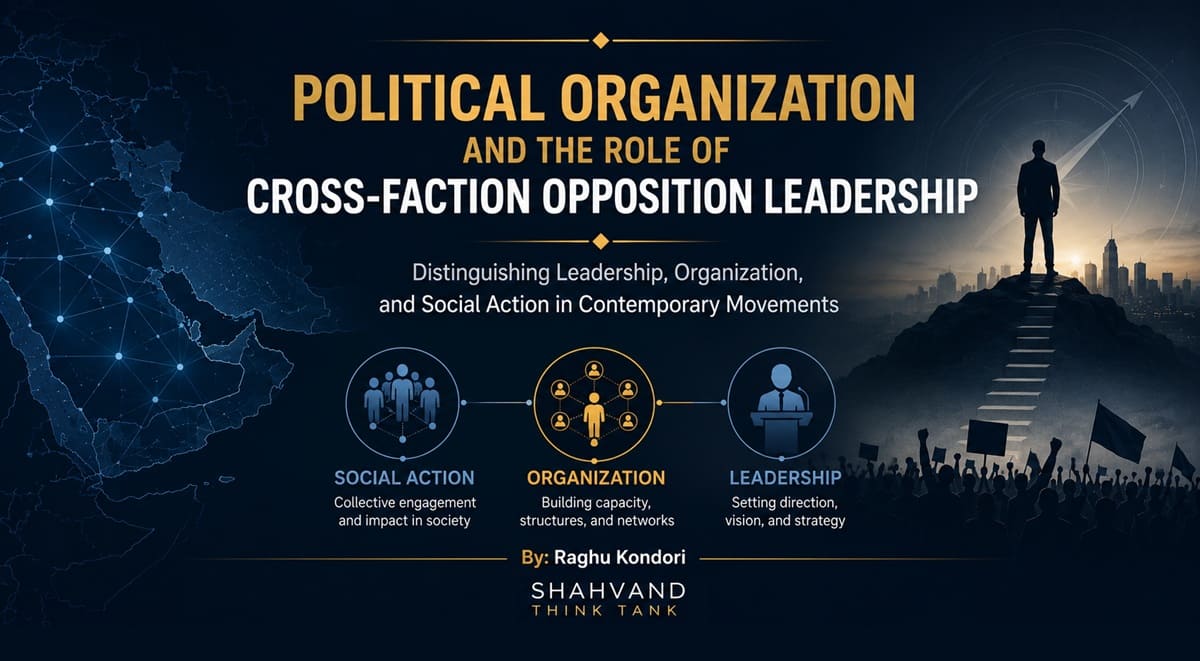
Political Organization and the Role of a Cross-Faction Opposition Leadership; By Raghu Kondori | Shahvand
Distinguishing Leadership, Organization, and Social Action in Contemporary Movements
Debates on political organization often begin with a simple assumption: that a single model can be designed and implemented across different societies. Yet political experience suggests something more complex. Organization is not a fixed structure, but a spectrum that emerges from real social conditions rather than abstract design.
What ultimately shapes political organization is not a pre-existing model, but a set of shifting constraints: levels of repression, the quality of communication, and the broader social capacity for sustained collective action. This distinction marks the boundary between a mechanical understanding of politics and a realistic one.
1) Organization as a Spectrum, Not a Fixed Model
Political organization is not a single, replicable form.
In practice, it spans a spectrum from centralized structures to distributed networks.
This spectrum is less a matter of choice and more a reflection of social conditions.
2) Limits of Centralized Structures under High-Risk Conditions
Centralized systems may function effectively in stable environments.
However, under conditions of repression, they become structurally vulnerable.
Alongside efficiency, centralization also produces a single point of failure.
3) Network Logic: Distributed Order under Pressure
Network-based forms are not necessarily ideological designs.
They are often adaptive responses to political reality.
Power and capacity are distributed rather than concentrated, reducing dependency on a single center and increasing resilience under disruption.
4) Minimal Organization: A Condition for Continuity, Not a Tactical Choice
No network can function without a minimal level of internal cohesion.
Minimal organization refers to small, trusted, disciplined units with basic role differentiation.
Its purpose is not control, but continuity under unstable conditions.
5) Between Symbolic Action and Social Impact
Political action is not limited to formal structures or decision-making processes.
A significant part of it emerges through everyday practices and symbolic acts.
This layer affects both internal cohesion and external social perception.
6) Communication Breakdown and Structural Adaptation
In crisis environments, communication infrastructure is never guaranteed.
Political structures therefore adapt by relying on limited but reliable channels.
Sustainability in such conditions depends more on adaptation than central coordination.
7) The Core Distinction: Leadership vs. Social Organization
Leadership and organization operate on different levels and should not be conflated.
Organization emerges from social relations and lived interactions.
Leadership operates at a strategic level, producing direction and political horizon.
8) Political Leadership as Horizon-Making, Not Network Management
The role of a cross-faction opposition leadership is not organizational management.
It operates at the level of strategy, meaning, and political direction.
Its function includes defining horizons, creating narrative coherence, and opening international channels of political engagement.
9) Three Levels of Politics: Leadership, Organization, Action
A proper understanding of political movements requires separating these three layers.
Leadership generates direction, organization builds capacity, and action translates capacity into reality.
Confusing these levels leads to analytical distortion.
10) Balancing Effectiveness and Resilience
The central question is not choosing between centralization and dispersion.
The real challenge lies in balancing political effectiveness with social resilience.
Structures that maintain this balance are more likely to endure under pressure.