Kurdistan Tourism & Wellness Corridor
A Strategic Proposal for a Secular Democratic Iran. Raghu Kondori | Shahvand Think Tank
Kurdistan possesses the foundations to become one of the most unique tourism and wellness destinations in West Asia. Its mountains, forests, lakes, villages, music, hospitality, spirituality, and ecological diversity create the conditions for a new regional economy built not around extraction or centralized dependency, but around culture, ecology, human experience, and sustainable development.
This proposal is designed for a future secular democratic Iran emerging after the Islamic Republic period — an Iran reconnected to international tourism, foreign investment, open cultural exchange, and regional cooperation.
Under such conditions, Kurdistan could gradually evolve into one of the major tourism, wellness, and cultural destinations of the Middle East.
The project does not aim initially for mass tourism. Its objective is high-quality, identity-based, sustainable tourism capable of generating long-term economic development while preserving local culture and ecological balance.
The first phase can begin incrementally through eco-lodges, village tourism, mountain infrastructure, wellness retreats, festivals, and organic food systems.
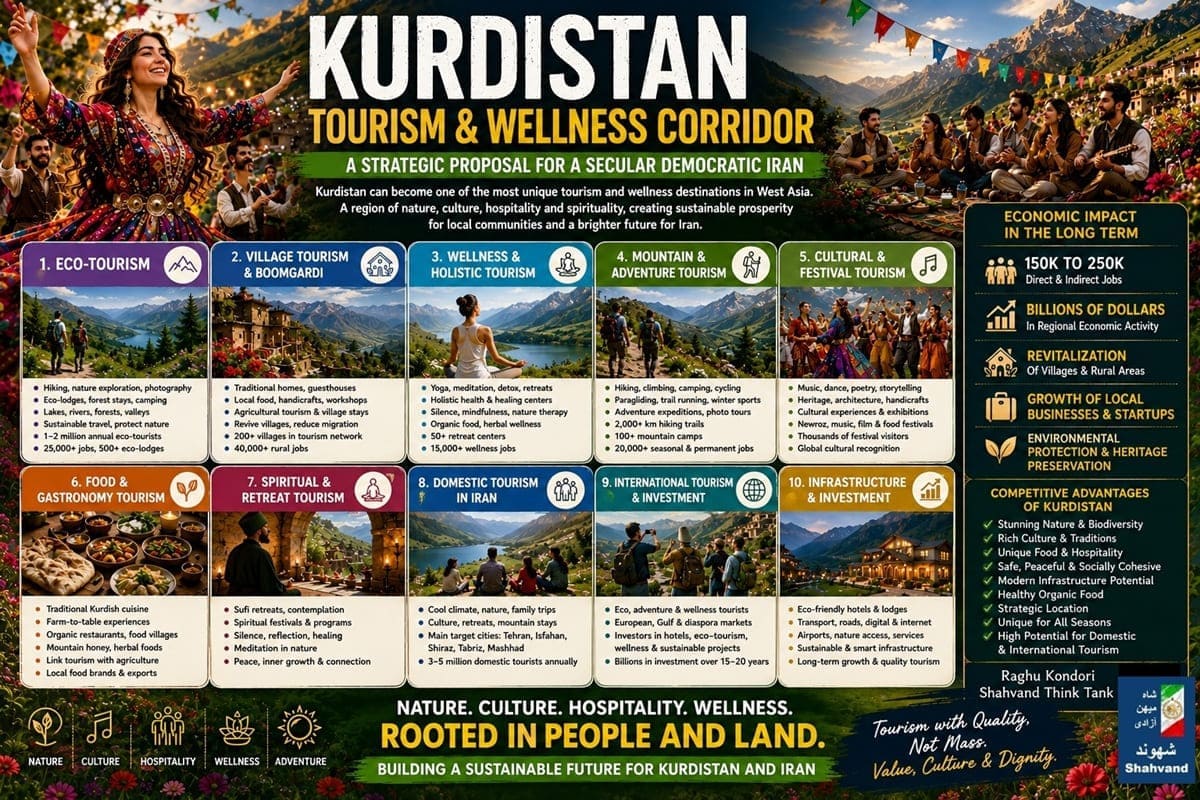
1. Eco-Tourism
Kurdistan’s mountains and natural landscape are among its greatest strategic assets. Regions such as Hawraman, Marivan, Lake Zarivar, Palangan, Baneh, and the Zagros mountain corridor possess exceptional potential for eco-tourism development.
The objective is not industrial tourism construction, but environmentally integrated tourism rooted in nature itself.
Tourism activities could include hiking, camping, forest retreats, photography tourism, cycling routes, mountain lodges, and ecological exploration.
Within 10 to 15 years, Kurdistan could realistically attract:
1 to 2 million annual eco-tourists,
develop more than 500 eco-lodges and rural accommodations,
and generate over 25,000 direct and indirect jobs connected to eco-tourism alone.
Unlike heavily commercialized destinations, Kurdistan still offers authenticity and untouched landscapes — increasingly rare assets in global tourism markets.
2. Boomgardi & Village Tourism
Village tourism may become one of the most transformative dimensions of the proposal.
Instead of abandoning rural regions, tourism can convert Kurdish village life itself into an economic strength. Traditional homes, local architecture, handicrafts, music, food traditions, and agricultural life become living economic assets rather than disappearing cultural memories.
A network of more than 200 villages could gradually integrate into the tourism economy through:
guesthouses,
traditional restaurants,
artisan workshops,
local markets,
mountain homestays,
and agricultural tourism.
This model creates direct income inside villages while reducing migration pressure toward major cities.
Over time, village tourism alone could generate more than 40,000 rural jobs across Kurdistan.
3. Holistic & Wellness Tourism
One of Kurdistan’s most unique opportunities lies in wellness and retreat tourism.
The combination of mountains, silence, cool climate, forests, spirituality, and ecological living creates ideal conditions for:
yoga retreats,
meditation retreats,
burnout recovery programs,
digital detox tourism,
nature healing,
mindfulness retreats,
and holistic health centers.
The proposal envisions the development of “Holistic Villages” around lakes, forests, and mountain valleys.
Around Lake Zarivar, for example, tourism infrastructure could include:
eco-cabins,
meditation gardens,
organic farms,
yoga pavilions,
herbal tea houses,
wellness restaurants,
forest walking paths,
and silence retreats.
This sector has major long-term economic potential. Global wellness tourism is already one of the fastest-growing tourism industries worldwide, worth hundreds of billions of dollars annually.
Within a secular democratic Iran, Kurdistan could realistically emerge as the wellness destination of the country and potentially of the broader region.
The sector could generate:
15,000+ direct jobs,
50+ retreat centers,
and attract both domestic and international visitors seeking nature, peace, and holistic living.
4. Mountain & Adventure Tourism
The Zagros mountains provide exceptional conditions for mountain tourism and outdoor sports.
Potential sectors include:
mountain hiking,
camping,
winter tourism,
cycling tourism,
climbing,
trail running,
adventure expeditions,
and landscape photography tourism.
Unlike crowded tourism markets, Kurdistan still possesses a feeling of openness and discovery that many travelers increasingly seek.
Over time, the region could develop:
2,000+ kilometers of hiking trails,
100+ mountain camps,
50+ mountain lodges,
and approximately 20,000 seasonal and permanent jobs connected to adventure tourism.
5. Cultural & Festival Tourism
Kurdistan possesses one of the richest cultural identities in the region. Its music, dance, poetry, clothing, storytelling traditions, architecture, and artistic heritage provide strong foundations for cultural tourism.
Tourism here is not only about landscape. It is equally about atmosphere, identity, memory, and human experience.
The proposal envisions major annual events such as:
Newroz International Festival,
Kurdish Music Festival,
Mountain Film Festival,
Sufi Music Festival,
Traditional Food Festival,
Photography Festival,
and Wellness & Yoga Festivals.
Festivals create immediate economic circulation across hotels, restaurants, transportation, local markets, and media visibility.
More importantly, they position Kurdistan culturally on both national and international levels.
6. Food & Gastronomy Tourism
Food itself can become a tourism sector.
Kurdistan possesses strong potential for organic agriculture, mountain herbs, natural dairy production, traditional bread, fermented foods, and holistic nutrition.
The proposal includes the development of:
organic restaurants,
farm-to-table tourism,
holistic food villages,
traditional Kurdish cuisine experiences,
mountain honey production,
and herbal food markets.
This creates a direct bridge between tourism and agriculture, ensuring that rural economic development benefits local communities rather than external corporations alone.
7. Domestic Iranian Tourism
The first major tourism market is domestic Iranian tourism.
Millions of Iranians already travel annually seeking cooler climates, nature, family tourism, cultural experiences, and temporary escape from dense urban life.
Cities such as Tehran, Isfahan, Shiraz, Tabriz, and Mashhad represent enormous tourism markets for Kurdistan.
If properly developed, Kurdistan could gradually attract:
3 to 5 million domestic tourists annually over the long term.
This domestic tourism base creates economic stability before dependence on international tourism markets.
8. International Tourism & Investment
A secular democratic Iran would radically transform Kurdistan’s international tourism potential.
Political normalization, open visa systems, banking integration, and improved global perception would attract:
European eco-tourists,
wellness travelers,
adventure tourism operators,
regional Gulf tourism,
diaspora tourism,
and sustainable development investors.
Potential investors may include:
hotel groups,
eco-tourism companies,
wellness brands,
festival organizers,
diaspora entrepreneurs,
and sustainable infrastructure funds.
Tourism-related investments over 15 to 20 years could reach several billions of dollars across accommodation, transportation, wellness infrastructure, festivals, and regional services.
Economic Impact
Tourism generates employment across multiple economic layers simultaneously.
Hotels, restaurants, transportation, eco-lodges, wellness centers, agriculture, festivals, local markets, digital tourism platforms, and handicrafts all become interconnected.
The long-term impact could realistically include:
150,000 to 250,000 direct and indirect jobs,
billions in regional economic activity,
revitalization of rural communities,
and the emergence of a new entrepreneurial economy across Kurdistan.
Sustainability & Strategic Balance
The success of the proposal depends entirely on balance.
Uncontrolled tourism can damage ecosystems, commercialize traditions, inflate property prices, and weaken local identity.
For this reason, the proposal emphasizes:
environmental protection,
local ownership,
architectural harmony with nature,
controlled development,
village-centered growth,
and sustainable infrastructure planning from the beginning.
Kurdistan should position itself not as a cheap tourism market, but as a high-quality destination rooted in:
nature,
culture,
hospitality,
wellness,
ecological living,
and human dignity.
Strategic Conclusion
Kurdistan possesses the foundations to become one of the most distinctive tourism and wellness regions in West Asia.
Its greatest strength is not only its landscape, but the convergence of:
mountains,
culture,
hospitality,
spirituality,
ecology,
human warmth,
village life,
and artistic identity.
If developed gradually, intelligently, and sustainably within a secular democratic Iran, Kurdistan could emerge over the next two decades as:
Iran’s eco-tourism center,
West Asia’s wellness destination,
a mountain tourism hub,
a cultural tourism capital,
and a model for sustainable regional development.
This proposal is not merely about tourism.
It is about building a new regional economic civilization rooted in ecology, culture, human experience, and dignity.
Raghu Kondori
Shahvand Think Tank