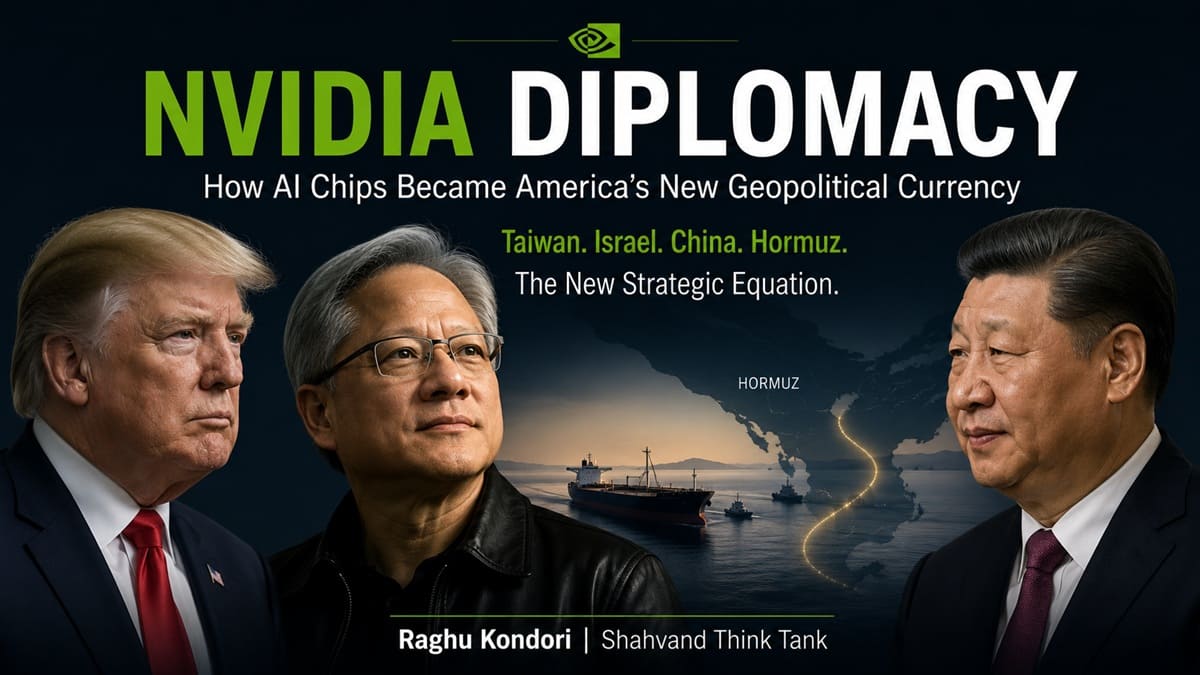

How AI Chips Became America’s New Geopolitical Currency
By Raghu Kondori
Artificial intelligence is no longer only a technological revolution. It is becoming a geopolitical system. At the center of that system stands Jensen Huang and Nvidia.
Nvidia today occupies a unique strategic position in the emerging world order. Taiwan forms the company’s manufacturing backbone, Israel increasingly functions as one of its advanced software and networking hubs, China remains the massive market Nvidia cannot fully abandon, and the United States controls the political and regulatory gate around advanced AI chips.
This is why Huang’s presence alongside Donald Trump during discussions connected to China matters far beyond business. AI hardware has now moved to the center of American diplomacy.
The logic is increasingly transactional. If Beijing wants broader access to Nvidia hardware and the American AI ecosystem, Washington can demand geopolitical cooperation in return. The Strait of Hormuz crisis creates exactly such an opportunity. China depends heavily on Gulf energy flows, and any prolonged maritime disruption directly harms Chinese economic interests.
In this context, advanced semiconductors become diplomatic currency.
The emerging message is straightforward: if China wants access to the engines powering the global AI revolution, Beijing must also play a stabilizing role in the Middle East and use its leverage over Iran to prevent escalation that threatens global trade and energy routes.
At the same time, Nvidia’s massive dependence on Taiwan changes the strategic meaning of the island itself. Taiwan is no longer only a territorial or ideological issue. It has become one of the core industrial foundations of the global AI economy. Any military conflict around Taiwan would now threaten not only regional stability, but the infrastructure behind the next technological era.
Israel occupies a different position in this architecture. While Taiwan manufactures the hardware foundation, Israel increasingly contributes to high-level AI research, networking systems, cybersecurity, and advanced software integration. Together, they form two essential pillars of Nvidia’s global ecosystem.
This creates a new geopolitical triangle.
Taiwan manufactures the body.
Israel strengthens the brain.
The United States controls access to the system.
China remains the market everyone wants but no one fully trusts.
The old diplomacy of the twentieth century revolved around oil pipelines, naval chokepoints, and military bases. The new diplomacy revolves around semiconductor supply chains, AI infrastructure, and computational power.
In this emerging order, Nvidia is no longer simply a company.
It is becoming a geopolitical instrument.