The New Conservative Order
America First, From Domestic to Foreign Policy. By Raghu Kondori, Director of Shahvand Think Tank. Integrated Strategic Policy Paper.
America First, from Domestic to Foreign Policy. A New Conservative Strategy to Secure the World.
A U.S. Grand Strategy for Breaking the Russia–China Axis Through Regime Change in Iran and Venezuela.
Integrated Strategic Policy Paper.
I. Introduction: The Pivotal Role of Iran
After the war between Hamas and Israel, the world has entered a pivotal era—one where U.S. global strategy, shifting alliances, and regional power struggles converge on a single catalytic point: the future of Iran.
A single, well-calculated strategic move could achieve what once seemed impossible.
What are these seven?
Bring Russia to a deal with the U.S. to end the war in Ukraine while weakening China’s global ambitions.
Secure Israel’s safety in a region fraught with existential threats.
Overcome Europe’s “double game”— blocking Russia while quietly engaging with China, Iran, and the Middle East.
Free Venezuela and reshape its role in the oil market; a future free Venezuela and Iran can replace Russia as suppliers of oil and gas.
Halt Iran’s nuclear ambitions and terrorist sponsorship.
Establish lasting peace in the Middle East through the Sirius Accord, connecting Iran, Iraq, Jordan, and Israel in a new economic and security framework.
Weaken BRICS unity and consolidate American influence from South Asia to Africa—separating India and Brazil from the BRICS treaty, expanding U.S. military presence in the Persian Gulf, Afghanistan’s Bagram base, Taiwan, South Korea, Japan, and ensuring U.S. access to raw materials and global financial hegemony under the USD.
II. America First Rebrands The Global Echo
For decades, globalism was shaped by the political left, emphasizing integration and interdependence. Yet globalism is not dying—it is evolving.
The “America First” slogan needs a global echo for its foreign policy. This is not a retreat into isolationism but a reconstruction of world order driven by a core principle: American power is the indispensable guarantor of global stability and the essential prerequisite for allied prosperity. “Conservative World” is the new paradigm, where the nationalist impulse to secure one’s own borders and prosperity empowers, rather than opposes, a strategic, value-driven global engagement.
Under the “America First” doctrine, globalism is being redefined to prioritize U.S. power, conservative values, and sovereign cooperation. The aim is not withdrawal but reconstruction—to build a world order where the U.S. and its chosen allies lead, rather than merely participate.
We are witnessing the birth of a new paradigm—“Conservative World”—where nationalism no longer opposes global strategy but empowers it. This new conservatism in foreign policy champions a pragmatic internationalism, rejecting the notion that prioritizing U.S. interests must necessitate the abandonment of alliances or the erosion of the international system. Instead, it asserts that a powerful, solvent, and self-assured America can more effectively shape a world friendly to freedom and free markets.
III. The Decline of China
Russia and China have recently deepened economic and strategic cooperation to counter U.S. dominance, challenge the dollar, and promote alternative global systems. Washington’s goal is to drive a wedge between them—offering Russia incentives to return to the Western fold while isolating China strategically.
The Kissinger doctrine succeeded once because the Soviet Union, though communist, was rooted in Western industrial ideals and rational modernism. China, however, was never a mirror of the West. Its Confucian pragmatism, patience, and strategic restraint allowed it to avoid Soviet-style collapse. It focused on small and medium industries, export capacity, and tech-driven growth—a strategy of Sun Tzu’s school: win without fighting, strike only when necessary.
Yet these same traits conceal vulnerabilities. China’s overdependence on cheap oil and resources from Iran and Africa exposes its structural fragility. Its “Silk Road” initiative is financially overstretched, while Beijing lacks the military reach to defend its global assets. If the Iranian regime collapses, Beijing would lose a major energy lifeline, a regional partner, and a vital lever against the United States.
IV. If the Red Dragon Cracks: Global Repercussions and Asia Pacific Policy
A crisis within China would rewrite the geopolitical map. Taiwan’s autonomy could gain global recognition; Hong Kong’s autonomy movement could reignite; and Tibet’s self-determination efforts might receive international support. Such shifts could unravel China’s territorial claims and challenge the Communist Party’s internal legitimacy.
Asia Pacific Policy: Recognizing Taiwan Autonomy
The New Conservative Global Order requires a clear, principled, and non-ambiguous Asia Pacific policy for recognizing Taiwan autonomy (Taiwan is not part of China). Taiwan is a vibrant, modern democracy that has successfully defended its sovereignty against constant political and military coercion from the People’s Republic of China (PRC). The historical facts are clear: Taiwan has never been governed by the PRC.
This new order must move beyond the strategic ambiguity that has dominated U.S. policy for decades. The pragmatic, conservative position must be:
Political Recognition: Support the democratic right of the Taiwanese people to determine their own future and actively work to increase Taiwan’s presence and standing in international organizations, recognizing it as a fully self-governing and autonomous political entity.
Defense and Deterrence: Significantly upgrade military support for Taiwan, ensuring it possesses an anti-access/area denial (A2/AD) capability sufficient to make any invasion attempt by the PRC prohibitively costly. A strong Taiwan is the first line of defense for the entire Pacific maritime order.
Economic Integration: Deepen trade and technological integration between the U.S., its allies (Japan, South Korea, India), and Taiwan, particularly in critical sectors like semiconductors, thus creating a shared economic stake that makes its defense a collective imperative.
The ultimate goal of this policy is to establish an Indo-Pacific Democratic Arc—anchored by Japan, South Korea, and Taiwan—that makes the democratic status quo in the region unchallengeable, thereby strategically encircling China and weakening the Communist Party’s ideological claim over the broader region.
V. The Linchpin: Non-Military Regime Change in Iran
No durable Middle Eastern peace—nor any coherent new world order—can emerge without addressing the Islamic Republic of Iran, a regime that has exported terror and instability since 1979. The strategy is to achieve a non-military regime change accelerated by financial pressure and political endorsement.
- The Political Catalyst: Parliamentary Monarchy
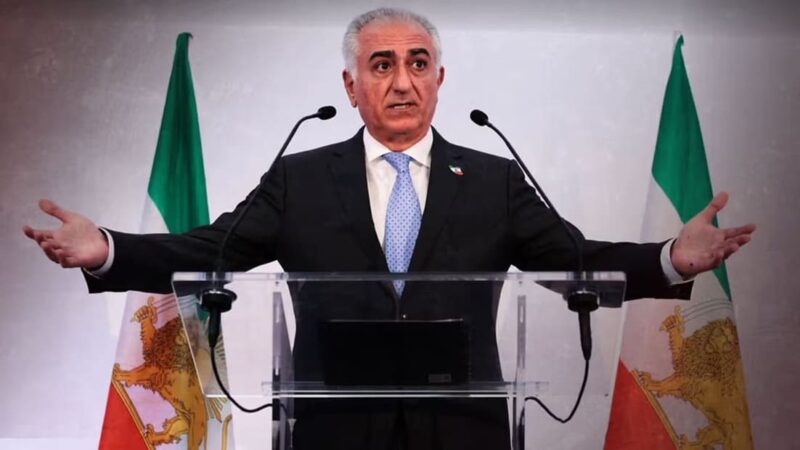
A political transition must be built around an inclusive, secular structure. The West must endorse Reza Pahlavi for a constitutional parliamentary monarchy. This specific framing mitigates the risk of a return to autocracy by ensuring the head of state (the monarch) is purely ceremonial and the head of government (Prime Minister) is chosen by a democratically elected Parliament. This structure ensures the ultimate power rests with the people and their vote, making the transition explicitly secular and democratic, while Pahlavi’s name serves as a unifying national symbol that may encourage the regular Iranian Army (Artesh) to remain neutral or defect.
- The Economic Accelerator: Starving the IRGC
The political blueprint for a parliamentary monarchy, while necessary for legitimacy, is not sufficient on its own to precipitate the collapse of the Islamic Republic. For the regime to fall non-militarily, the West must couple the political endorsement with the active financial strangulation of the Islamic Revolutionary Guard Corps (IRGC), which serves as the regime’s main source of internal power, terror funding, and geopolitical resilience.
This acceleration requires a three-pronged, non-military strategy focused on dismantling the IRGC’s economic and control infrastructure:
Financial De-Legitimization and Sanctions: The West must move beyond superficial sanctions to aggressively target the IRGC’s vast shadow banking network and its ‘bonyads’ (foundations), which are opaque economic empires used to generate revenue and reward loyalists. This means blacklisting institutions and extending secondary sanctions to foreign entities in the Persian Gulf and East Asia that facilitate the IRGC’s money laundering and oil-for-goods schemes. The goal is to starve the security forces of funds, making it difficult to pay and equip militias, leading to greater internal dissent and potential defections.
Cyber and Communications Support: To counter the regime’s digital surveillance and narrative control, the U.S. and its allies must provide and subsidize advanced satellite and VPN technology (such as Starlink hardware) to bypass the regime’s internet filtering. This support directly empowers internal Resistance Units and protest organizers by facilitating mass coordination and rapid information flow, thereby countering the regime’s monopoly on the narrative and accelerating the speed of public mobilization.
Targeted Amnesty and Defection Incentives: The West must publicly offer amnesty and a pathway to a secure, stable life for mid-to-high-level IRGC officers who defect and refuse to fire on citizens. This strategy is designed to exploit internal fissures between the hardline elite and the security forces on the ground, encouraging defections and accelerating regime destabilization from within by eroding the loyalty of the armed apparatus.
- The Venezuela Parallel
Venezuelan regime change would, in parallel, chart a new Latin America—one defined by democratic renewal and economic revival under the leadership of figures like María Corina Machado. This dual-front strategy accelerates political transition, restores sovereignty, and establishes two powerful democratic partners at the core of the Western hemisphere and the Middle East, simultaneously curbing narcotics and cartel influence.
VI. The Russian Financial Cataclysm: The Consequences of Energy Decoupling
The success of the New Conservative Global Order is predicated on one fundamental economic weapon: the complete replacement of Russian oil and gas supplies to India and Europe by a free Iran and Venezuela. The financial consequences for Russia would be immediate and devastating.
- Loss of Budgetary Revenue
Oil and gas revenues have historically accounted for 30–50% of the Russian federal budget, roughly equating to the amount Moscow spends on its military and the war in Ukraine. In the post-2022 sanctions environment, China and India became the dominant buyers of Russian crude exports. Losing the India market alone could mean Moscow forfeits an estimated $1.6 billion in monthly tax revenues. The combination of losing both India and the remaining resilient European gas/LNG markets would lead to the loss of the majority of Russia’s seaborne oil revenue and virtually all of its pipeline gas revenue. This collapse in revenue would immediately create a massive, unfinanceable budget deficit, directly crippling its ability to fund its military and domestic programs.
- Financial Dependence on China and Price Collapse
The loss of India and Europe leaves Russia almost entirely dependent on China as its sole major customer for oil and pipeline gas. This grants Beijing immense pricing leverage, forcing Russia to sell its remaining supply at deeper and deeper discounts, further eroding net revenue. This deep dependence is a political and economic nightmare for Moscow, sacrificing its strategic autonomy to its supposed partner. Furthermore, Russia’s gas giant, Gazprom, has no quick way to redirect European volumes to China, a logistical hurdle that leaves Russia’s gas revenue crippled for the foreseeable future.
- The Strategic Energy Ramp-Up Timeline
While the strategy is sound, the transition of supply from Russia to Iran and Venezuela requires a realistic timeline, recognizing the substantial technical hurdles built up over years of sanctions and mismanagement.
Iran: The Rapid Supplier. Iran holds vast reserves and, critically, possesses a significant amount of existing production capacity that is currently shut-in due to sanctions. Upon regime change and the rapid lifting of sanctions, Iran could swiftly increase its output. Initial increases would come from the immediate sale of floating storage (oil currently held on tankers). A substantial short-term increase of 0.8 to 1.2 million barrels per day (bpd) is possible within 6 to 12 months by simply reopening existing wells and returning to pre-sanctions production levels. Over the medium term (3–5 years), with foreign investment and technology returning, Iran could push its production to over 5 million bpd, fully replacing Russia’s lost crude volume to key markets.
Venezuela: The Long-Term Project. Venezuela, despite holding the world’s largest proven oil reserves, presents a far more complex recovery challenge due to over a decade of severe infrastructure decay and chronic underinvestment. While initial sanctions relief could immediately boost output by 200,000 to 400,000 bpd within the first year, large-scale recovery is a protracted affair. The heavy nature of Venezuelan crude requires specialized diluents and functioning upgraders (processing facilities), most of which are currently in disrepair. Venezuela could realistically reach its pre-crisis production of 2.5 to 3.0 million bpd only within a 5-to-10-year timeframe, contingent on the full restoration of the rule of law and sustained annual investments exceeding $10 billion.
The combined immediate ramp-up of Iran’s shut-in capacity and Venezuela’s initial recovery is sufficient to create a massive global oil surplus, depressing prices and immediately collapsing Russia’s oil revenue. The success of the New Conservative Global Order’s energy strategy transforms Russia from a geopolitical aggressor backed by petrodollars into a financially isolated, China-dependent client state, achieving the primary goal of ending the war on favorable terms without direct military engagement.
VII. Building the Tri-Continental Conservative Arc
To realize this vision, a new alliance of right-leaning and pragmatic states must emerge—the Tri-Continental Conservative Arc:
Indo-Pacific: Japan, South Korea, Taiwan, and India as democratic anchors.
Middle East: Israel, Jordan, Iraq, and a free Iran as the strategic pillar.
Atlantic/Europe: Argentina, Italy, Hungary, and other pragmatic, sovereign democracies.
This bloc anchors a Conservative World grounded in national sovereignty, economic realism, and moral clarity—reshaping global integration around strength, productivity, and shared conservative values. Japan and South Korea must be recognized as critical anchors of the Pacific flank of the New Conservative Order, embodying the balance between sovereignty and alliance, and consolidating the eastern vanguard of Conservative World.
VIII. The Sirius Accord: Completing the Abraham Accords
The Abraham Accords normalized ties between Israel and Arab states but remained primarily economic and limited to intelligence cooperation.
The Sirius Accord would go further—it would complete what the Abraham Accords began by formalizing full diplomatic recognition of Israel and including broader regional partners such as a free Iran, Jordan, Iraq, Tajikistan, India, Venezuela, Argentina, and the United States. The Sirius Accord establishes a comprehensive alliance for peace, energy, and strategic development, replacing the paradigm of conflict with one of integrated infrastructure, regional defense, and secular governance.
IX. The Peril of Policy Drift: The Necessity of Leading Conservative World
Without a new and strong foreign policy for leading Conservative World, America in the long term will risk weakening the trust and hegemony of its allies. This strategic drift will inevitably push key partners to look toward the China-Russia axis, a dangerous dynamic that is already evident in the European Union (EU), Africa, and the Middle East:
Europe’s Duplicity: Hedging against perceived U.S. unpredictability by increasing economic engagement with Beijing.
Africa’s Pivot: Ceding influence to China (economic deals) and Russia (security/mercenary services) in the absence of a robust American alternative.
Middle East’s Hedging: Diversifying security relationships (joining BRICS, buying Russian arms) due to the lack of a reliable, long-term U.S. security guarantee against a destabilizing Iran.
Failing to embrace this aggressive, value-based global strategy condemns America to managing decline, watching its allies slowly but surely be absorbed into the gravitational pull of the Sino-Russian alternative. The time for ambiguity is over.
X. The New Conservative World Order
This is how the United States and its allies can “kill seven birds with one stone”:
Split Russia from China.
Secure Israel and transform the Middle East.
Replace Russia as the world’s energy supplier through Iran and Venezuela.
Weaken China’s global leverage.
Neutralize Europe’s duplicity.
Establish a right-led global alliance of free nations.
Anchor global peace through the Sirius Accord.
The Sirius Accord is the vehicle. The New Conservative Global Order is the destination.
With courage, coordination, and conviction—a new era of peace, prosperity, and pragmatic power is within reach.
Raghu Kondori, Director of Shahvand Think Tank. December 2025