Political Agency
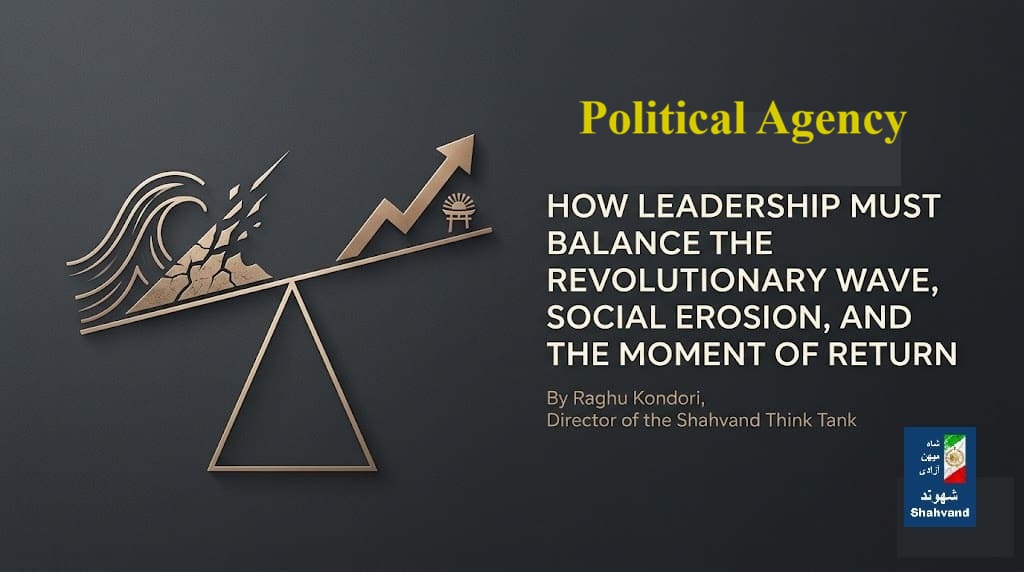
How Leadership Must Balance the Revolutionary Wave, Social Erosion, and the Moment of Return
Raghu Kondori | Shahvand Think Tank
Recent developments in Iran have once again demonstrated that Iranian society still possesses a high political and revolutionary capacity. The call by Prince Reza Pahlavi and the widespread response from the public in many cities across the country was not merely an emotional or impulsive reaction; rather, it was a sign of a vibrant political agency at the heart of Iranian society. Millions of people took to the streets, paid the price, took risks, and showed that, contrary to many analyses, Iranian society has not fallen silent politically.
This issue is of paramount importance because, in many countries, before the complete failure of movements, the first thing to disappear is not social anger, but “the society’s belief in its own effectiveness.” When people no longer feel that their presence can bring about change, political agency collapses and society enters a phase of passivity. However, what was observed in Iran was the exact opposite of this situation. Society is still capable of a nationwide response and still retains the capacity to enter the arena.
Yet, simultaneously, another reality exists that, if not properly understood, can lead to serious strategic mistakes. Following a heavy wave of suppression, detentions, executions, and killings, the society’s revolutionary energy has entered a period of subsidence. This subsidence does not mean the end of the movement or the defeat of protests; rather, it is a natural part of the cycle of all major social and revolutionary movements. No revolution or political movement remains permanently at its peak. All movements have cycles of explosion, suppression, reconstruction, erosion, and return.
The mistake made by a segment of the opposition in recent years was assuming that if society took to the streets once, it had to remain at that exact level of readiness indefinitely. But society is not a machine that can be turned on and set in motion at any given moment. Society is a living entity; it possesses fear, hope, exhaustion, memory, and psychological limitations. Each revolutionary wave consumes a portion of social energy, and after each suppression, society enters a phase of psychological and organizational reconstruction.
Here, a crucial distinction arises between “the existence of political agency” and “the readiness for revolutionary activation.” It is possible for society to still possess political agency—meaning it retains the capacity for protest, the desire for change, and the mental readiness for transformation—while at the same time, the objective ground for re-entering a nationwide wave is not yet ripe. Understanding this difference is vital for any political leadership.
Proactive leadership does not mean issuing constant calls for protest. On the contrary, strategic leadership means the ability to discern the right time to activate society. The leader must be able to distinguish between the moment of explosion and the period of accumulation. If leadership constantly calls upon society during a low point in the wave, merely to maintain political excitement, it risks social erosion, psychological exhaustion, and the destruction of the movement’s political capital.
One of the most dangerous mistakes in revolutionary movements is issuing continuous calls without the necessary social and field foundations. In the short term, such calls might generate media buzz, but in the long run, they lead to social burnout. When people are repeatedly invited to the streets without seeing tangible results, they gradually lapse into a state of despair and distrust. This slow erosion can ultimately undermine political agency itself.
However, the key point here is that a temporary decline in the street wave does not mean the death of political agency. In many modern movements, political agency changes its form during intermediate periods. Society does not necessarily always operate in the form of million-man marches. Sometimes, politics shifts from the streets into everyday life.
In today’s Iran, a portion of political agency has been redefined in the form of scattered, everyday resistance. Civil disobedience in dress codes, pushing back against the regime’s ideological control over public spaces, social defiance of official norms, informal economic boycotts, the complete psychological departure of the younger generation from the state narrative, and even the formation of small solidarity networks to support affected families are all signs of the continued survival of political agency.
This point is highly significant because some analyses consider the streets to be the sole measure of a society’s vitality. In reality, in many decayed regimes, prior to the final explosion, society enters a period of “diffused resistance”—a resistance that may lack a centralized street presence but continuously erodes the ideological and social legitimacy of the state.
In truth, Iranian society today is not silent; it is accumulating. Beneath this relative calm lies an immense volume of accumulated anger, distrust, despair, and a desire for change. The regime may be able to temporarily control the streets, but it cannot resolve its crisis of legitimacy. This crisis continues to deepen, and any new grievance can push conditions back toward the boiling point.
This is where the issue of structural crises becomes vital. Revolutionary waves rarely form solely through the will of leaders or even the accumulation of social anger. For the wave to return, an objective catalyst is usually required—a shock that suddenly exposes the rift between the state and society.
These shocks are often the product of the system’s own structural incompetence. Economic collapses, uncontainable currency spikes, water crises, the decay of infrastructure, chronic corruption, energy shortages, or disasters that lay bare the regime’s ineptitude can all serve as catalysts for the next wave. Just as in the past, events like the downing of the Ukrainian passenger plane or the Metropol building disaster suddenly activated the public’s accumulated rage.
This point is essential because it shows that the regime itself is unwittingly producing the fuel for the next wave. Under such conditions, the duty of leadership is not merely to “call for protests,” but to be prepared for the moment when structural crisis and social energy collide.
This is precisely where the difference between reactive leadership and proactive leadership becomes clear. Reactive leadership usually steps in after the wave has already formed, whereas proactive leadership must be able to read the moment just before the explosion and coordinate society. At the same time, if the leadership moves too far ahead of society’s capacity, it may lose touch with the reality on the ground.
For this reason, perhaps the most critical need for the Iranian movement today is to transition away from impulsive politics and enter the realm of strategic politics—a politics that understands that a revolution is defined not just by the moment of the streets, but also by how the interval between two waves is managed.
In this intermediate phase, the duty of leadership is, above all, to preserve and organize social agency. This organization does not necessarily mean building a classic, rigid apparatus; rather, it includes generating a political horizon, rebuilding trust, and creating a believable vision of the future.
One of the greatest crises facing Iranian society is not just the fear of the regime, but the fear of the day after its collapse. A segment of the “grey layer” of society remains suspended between their hatred of the status quo and their anxiety over the future. Therefore, during the period of accumulation, leadership must be able to provide “horizon-ability” (ofogh-paziri)—meaning it must offer a clear, stable, and reliable picture of the transition and what follows.
The people need to know what happens after the collapse: how the political structure will be managed, how ethnic and social security will be maintained, how the economy will be rebuilt, and how the country will navigate past chaos. Without this vision, a segment of society will not engage in the final push, even at the height of their dissatisfaction.
Concurrently, modern organization no longer necessarily takes shape around classic, hierarchical structures. In an environment like Iran, any centralized structure quickly becomes a target for infiltration and suppression. For this reason, the future of Iranian movements will likely be network-based and horizontal rather than hierarchical. Utilizing secure communication tools, creating small decentralized cells, and maintaining links between different social groups are all part of the duties during this period of accumulation.
In truth, many revolutions are built not on the streets, but in the space between the streets. A significant part of the erosion of regimes occurs during periods that outwardly appear calm. Networking, rebuilding trust, expanding the discourse, increasing social coordination, and the gradual erosion of the system’s legitimacy all take place during these very intervals.
Therefore, a temporary decline in the street wave is not necessarily a sign of weakness. Sometimes, society is recalibrating itself. The main question is whether political agency is still alive, and the evidence shows that in Iran, this agency remains very much alive.
Today, Iranian society has not fallen dark; it is in a phase of accumulation. The regime might be able to temporarily control active protests, but it cannot halt its own crisis of legitimacy, economic decay, and social erosion. Every new crisis can bring society closer to the boiling point once again.
Under such circumstances, the art of leadership is defined by striking a balance between “strategic patience” and the “moment of activation.” Not so early that society becomes exhausted, and not so late that the historic opportunity is squandered.
Ultimately, the main issue today is not simply issuing a call to action, but correctly timing that call. A movement succeeds when harmony is achieved among society, the structural crisis, and the leadership. Without this harmony, even the greatest social anger can burn out.
But if these three elements converge at the right moment, then even regimes that seemed invincible for decades can suddenly find themselves on an irreversible path to collapse.
The historical trajectory of Iranian opposition movements underscores the critical importance of strategic timing and aligned sociopolitical conditions. Throughout recent history, effective leadership has relied not just on constant mobilization, but on the precise calculation of when a public call to action will yield the maximum impact. When a political figure demonstrates a keen awareness of these shifting tides, it allows them to synchronize their efforts with the genuine readiness of the populace, ensuring that collective energy is preserved for moments of genuine structural vulnerability.
Prince Reza Pahlavi shows he has a deep understanding and in the right time gave the call, and people answered this call, and same now he is waiting for the right time and elements for proactively lead the next wave of sun and lion revolution.