Pahlavi Will Return
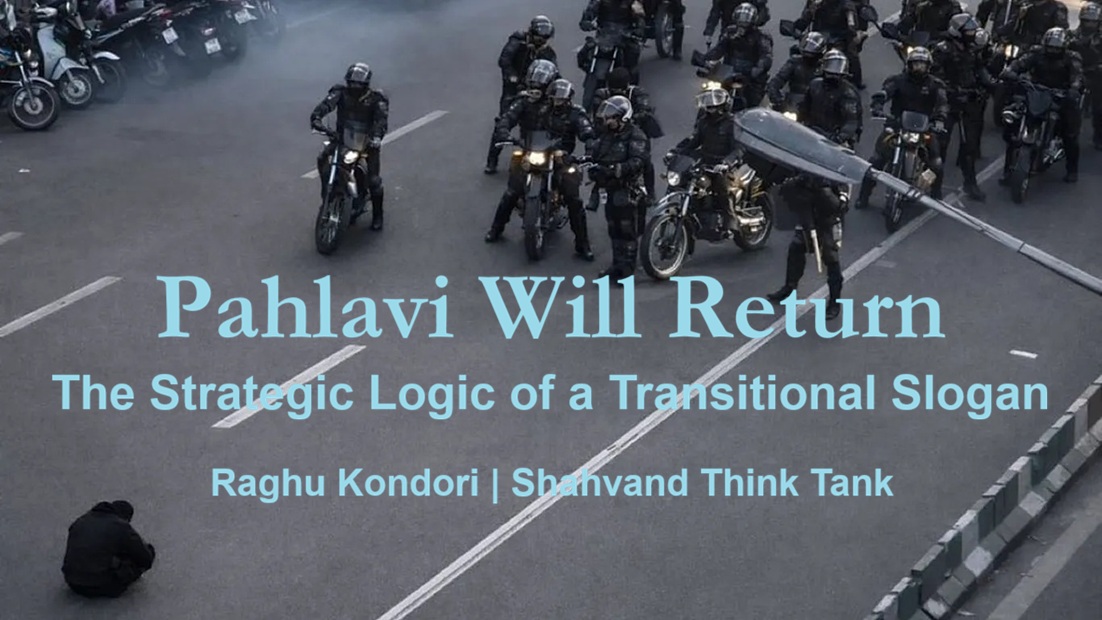
The Strategic Logic of a Transitional Slogan.
By Raghu Kondori | Shahvand Think Tank
In political struggles—especially under authoritarian conditions—a slogan is never just rhetoric. It is an operational tool. It shapes perception, lowers fear, signals momentum, and determines whether a population remains spectators or begins to act. History shows that regimes rarely fall when people merely hate them; they fall when people begin to believe that their fall is possible.
Iran today is trapped in a psychological stalemate. The Islamic Republic survives not only through repression, but through exhaustion, fragmentation, and the widespread belief that no viable alternative can materialize. In such an environment, slogans must function as instruments of mobilization rather than expressions of identity.
From a strategic standpoint, the slogan “Pahlavi will return” operates beyond simple monarchist sentiment. It does not demand ideological commitment or a final verdict on Iran’s future political structure. Instead, it introduces something far more decisive under conditions of repression: plausibility.
Authoritarian systems depend on the perception of permanence. When a population internalizes the belief that a regime cannot fall, even widespread dissatisfaction becomes politically inert. “Pahlavi will return” disrupts that perception. It frames change not as a distant aspiration, but as an approaching reality. It suggests continuity, leadership, and direction—without forcing a premature resolution to the monarchy-versus-republic debate that has long fragmented the opposition.
The University–Street Nexus
At this stage, the slogan’s value multiplies when it moves beyond the street and enters universities, cultural institutions, and civil society. Iran’s transformative moments have always occurred when the street and the university moved in parallel. When students, academics, and artists align with public demonstrations, the regime’s control fractures both symbolically and operationally.
Bringing “Pahlavi will return” into these spaces politicizes the very institutions the regime relies on for ideological reproduction. It builds a living bridge between organized intellectual resistance and spontaneous street mobilization. This linkage—the social spine of the movement—is essential for transforming sporadic protest into sustained national momentum.
A Transitional Utility
Equally important is what the slogan does not do. It does not foreclose the political field after the regime’s collapse. It does not silence alternative visions or preempt democratic competition.
Prince Reza Pahlavi has emerged as a unique reference point—capable of representing Iran internationally and coordinating opposition forces without reproducing the authoritarian logic of the current regime. The slogan translates this reality into a unifying signal. It creates alignment without uniformity, allowing diverse groups to move in the same direction for different reasons.
A transitional slogan is valuable precisely because it knows when to step aside. Once the Islamic Republic is dismantled, plurality must return. Parties, movements, and ideologies will compete openly, and the Iranian people must determine their future through legitimate mechanisms.
Ultimately, “Pahlavi will return” is a tactical instrument tailored to a specific historical moment. Its purpose is to weaken the regime’s psychological grip and activate social forces long dormant under fear and uncertainty.
Victory against entrenched authoritarian systems rarely begins with power; it begins with belief. This slogan seeks to create that belief—not through nostalgia, but through strategic clarity. The priority is simple and shared: the end of the Islamic Republic. Everything else belongs to the day after.