The Lion and Sun Revolution
An Analysis of the Strategic Update of Prince Reza Pahlavi.
Shahvand Think Tank Report
Prince Reza Pahlavi’s recent statement must be understood within the context of on-the-ground realities, not merely at the level of slogans or symbolism. Following the mass killings and brutal repression of opponents—during which tens of thousands of citizens, many of them families who took to the streets with their children in peaceful demonstrations across Iran, were subjected to systematic violence—the continuation of a static strategy was no longer viable. Under such conditions, updating strategy is not a political preference, but a necessity for the defense of Iran and the Iranian people. What we are witnessing is a paradigm shift in the mode of struggle.
Within this framework, the shift in language from “regime change” to “revolution” becomes meaningful. Regime change is a managerial, elite-driven, and largely containable concept. Revolution is the response to a regime that has used naked violence to block all avenues of peaceful protest. Revolution, by contrast, is the response to a regime that has used naked violence to block all avenues of peaceful protest. When unarmed street presence is met with live ammunition, and the boundary between protester and non-protester collapses, a gradualist strategy becomes not only ineffective but morally and politically exhausted.
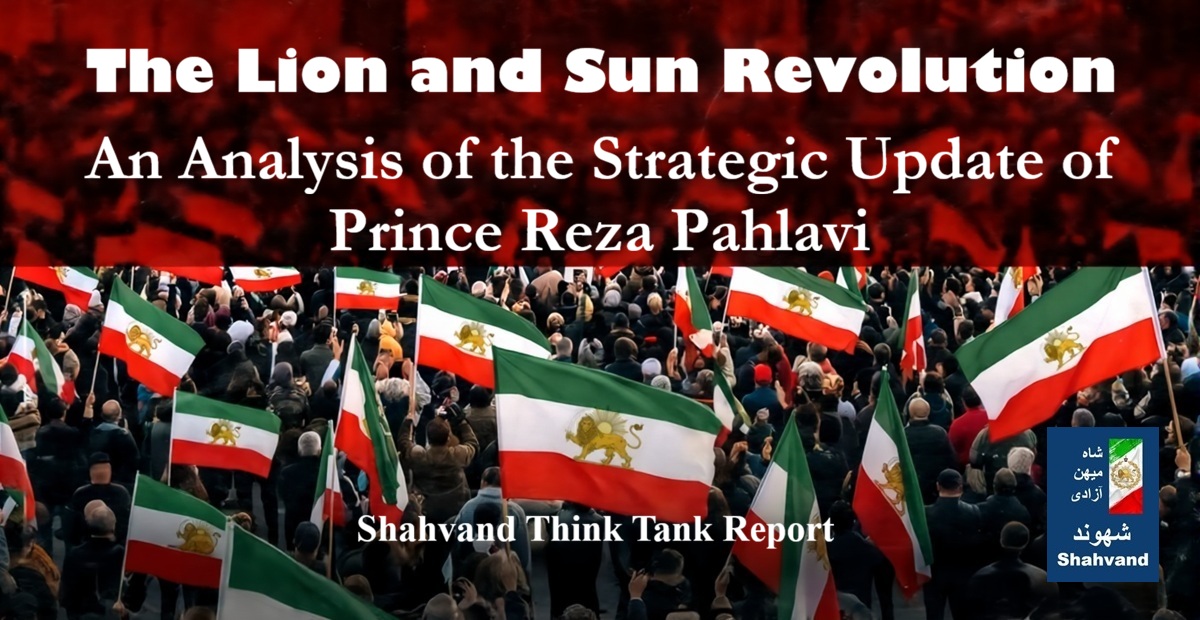
It is in this context that the concept of the “Lion and Sun Revolution” emerges. This concept is neither nostalgic nor a return to the past. Rather, it is a deliberate effort to redefine the identity of the movement. The Lion and Sun, as a historical symbol of Iran, functions as an ideological alternative to Islamic rule, shifting the source of future legitimacy from religious ideology to Iranian historical and national continuity. This transformation moves the movement out of a reactive posture and places it in the position of defining the contours of a future political order.
At the same time, the introduction of the idea of a “transitional government” demonstrates that this radicalization is neither emotional nor purely street-driven. The call for readiness to recognize a transitional authority—despite the fact that such a government has not yet been formally announced—is a preemptive move aimed at preventing a political vacuum and preparing the post–Islamic Republic horizon. At this stage, the Iranian opposition moves beyond a protest-centered role and enters the domain of political responsibility.
Following such levels of state violence and the complete closure of peaceful pathways, a strategic update became unavoidable. The recent statement signals acceptance of this reality and entry into a new phase. The movement has now entered the phase of forming an alternative power bloc. In this phase of action, the street—inside and outside Iran—is no longer merely a site of protest, but a platform for demonstrating the legitimacy of a transitional government and a means of exerting pressure on the international community to grant it formal recognition.
The Lion and Sun Revolution for the reclamation of Iran.
Shah, Homeland, Freedom