
A global stage for the competition of narratives. By Raghu Kondori
With the start of the World Cup, the old question arises once again: does presence in the stadiums mean reinforcing the Islamic Republic’s narrative, or is it an opportunity to reflect the true voice of the Iranian nation?
In the media age, the primary arena of political competition takes shape not merely in the realm of power, but in the management of narratives and public image-making. The World Cup, with its audience of millions, is one of the greatest opportunities to deliver a message to global public opinion.
Many opponents of the Islamic Republic want to display the Sun and Lion flag in stadiums, but FIFA’s restrictions and tournament regulations do not always allow for such an option. Under these conditions, simpler and more effective solutions also exist.
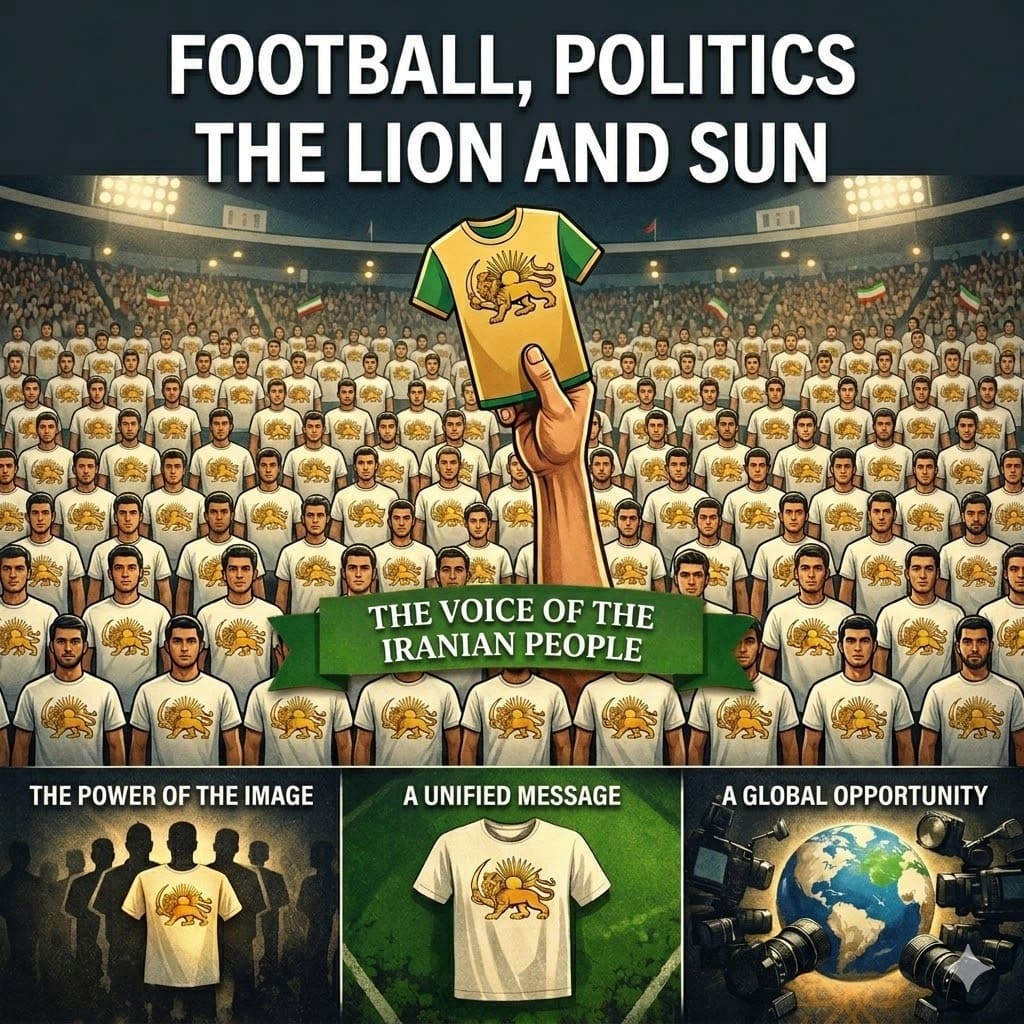
Imagine thousands of Iranians present in specific sections of the stadium wearing white T-shirts adorned with the Sun and Lion emblem. Such an image will create a clear, coordinated, and unignorable message for global cameras. The power of this movement lies in its simplicity, repetition, and cohesion; because the global audience sees the image first and then comprehends the message.
Within this framework, the “Sun and Lion Revolution” is not just a flag or a slogan, but a distinct concept for the convergence of Iranians inside the country and the diaspora around a shared national symbol—a symbol that can be the unified language of an all-encompassing movement for freedom, national identity, and the future of Iran.
The World Cup is not just a sporting event; it is a global stage for the competition of narratives. Success in this arena depends not on presence or absence, but on the capacity for organization, cohesion, and message management. If this capacity takes shape, the Sun and Lion can become the unified and organized language of the #Sun_and_Lion_Revolution.